2026-04-16 東京科学大学
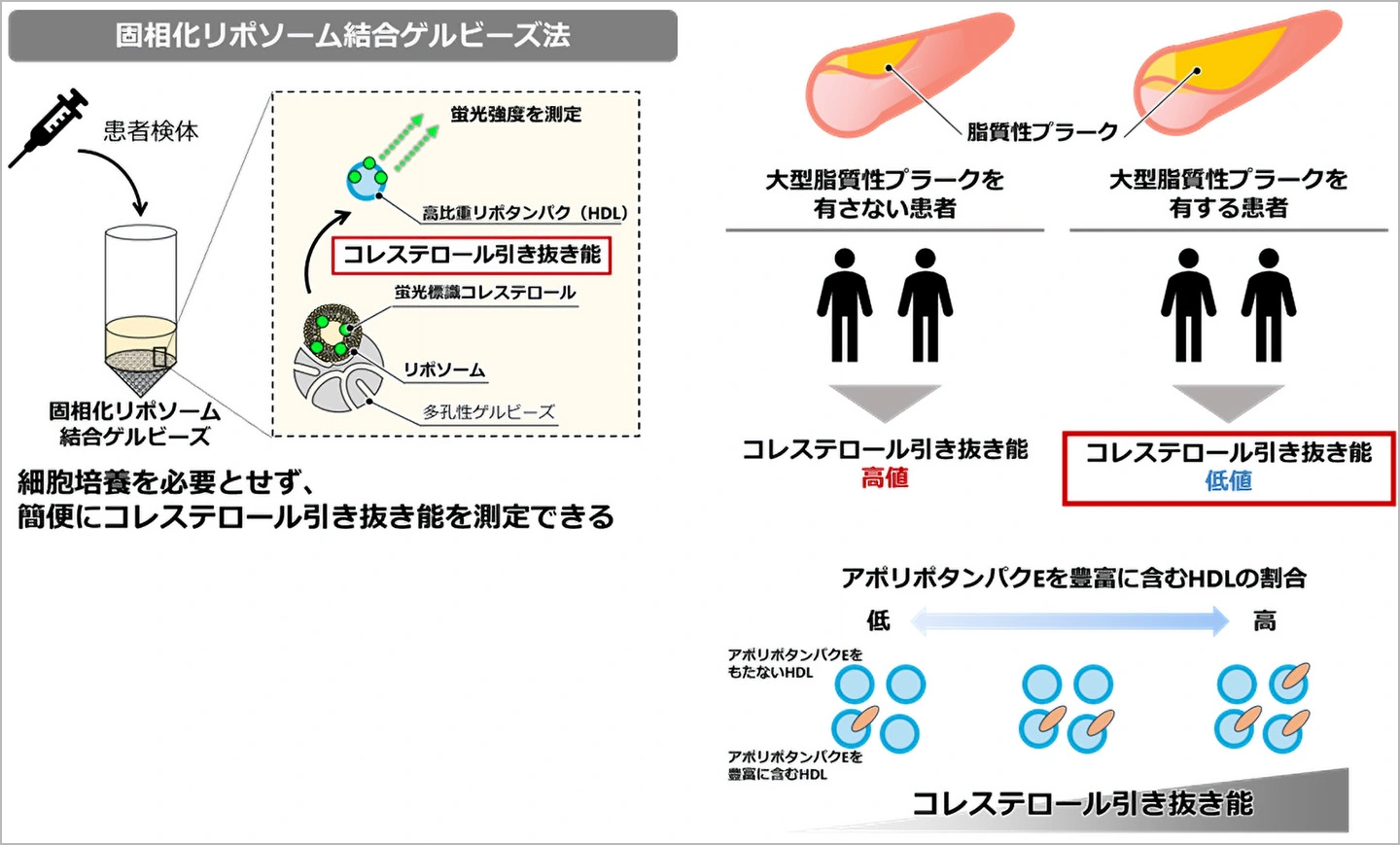
図1. 本研究成果の概要
<関連情報>
- https://www.isct.ac.jp/ja/news/6d3d151lh1bf
- https://www.atherosclerosis-journal.com/article/S0021-9150(26)00090-0/fulltext
光干渉断層撮影法による動脈硬化性病変と、固定化リポソーム結合ゲルビーズ法によるコレステロール排出能との関係 Relationship of atherosclerotic lesion by optical coherence tomography with cholesterol efflux capacity by immobilized liposome-bound gel beads method
Tsunehiro Miyakoshi ∙ Yuna Horiuchi ∙ Makoto Araki ∙ … ∙ Minoru Tozuka ∙ Tetsuo Sasano ∙ Ryunosuke Ohkawa
Atherosclerosis Published:April 2, 2026
DOI:https://doi.org/10.1016/j.atherosclerosis.2026.120724
Highlights
- CEC measured by ILG method is positively associated with the abundance of apolipoprotein E-containing HDL.
- CEC values measured by the ILG method are lower in patients with large lipid-rich plaque than in those without.
- The ILG assay can evaluate HDL quality, supporting its usefulness for cardiovascular disease risk assessment and prognosis.
Abstract
Background and aims
Cholesterol efflux capacity (CEC) is robust biomarker for atherosclerotic cardiovascular disease (ASCVD). However, cell-based CEC assays require complex procedures that limit clinical use. The immobilized liposome-bound gel beads (ILG) method, a newly developed cell-free CEC assay, demonstrates sufficient performance for clinical application. This study investigated the clinical significance of CEC measured by the ILG method in relation to HDL subclasses and coronary artery plaque characteristics.
Methods
We analyzed CEC and HDL parameters, including the ratio of apolipoprotein E (apoE)-HDL-C to HDL-C (%apoE) and HDL3-C/HDL2-C, in 61 patients who underwent coronary angiography or percutaneous coronary intervention. Coronary artery plaques were assessed by optical coherence tomography (OCT). A large lipid-rich plaque was defined as lipid length >5 mm and lipid arc >180°.
Results
CEC correlated positively with HDL-C and %apoE. Among the patients, 26 (42.6%) exhibited large lipid-rich plaques on OCT. Univariable analysis showed that CEC was significantly lower in patients with large lipid-rich plaques compared to those without. While this association did not reach statistical significance after multivariable adjustment (p = 0.109), the addition of CEC to traditional risk factors improved the model’s explanatory power (Nagelkerke R2: 0.346 to 0.381) and discriminatory ability (AUC: 0.775 to 0.805) for large lipid-rich plaques.
Conclusions
CEC measured using the ILG method reflects HDL subclass features and is associated with the burden of lipid-rich coronary artery plaques. These findings suggest the significance of CEC evaluated using the ILG method, supporting its potential for enhanced ASCVD risk assessment and further clinical applications.