2026-04-16 長寿医療研究センター
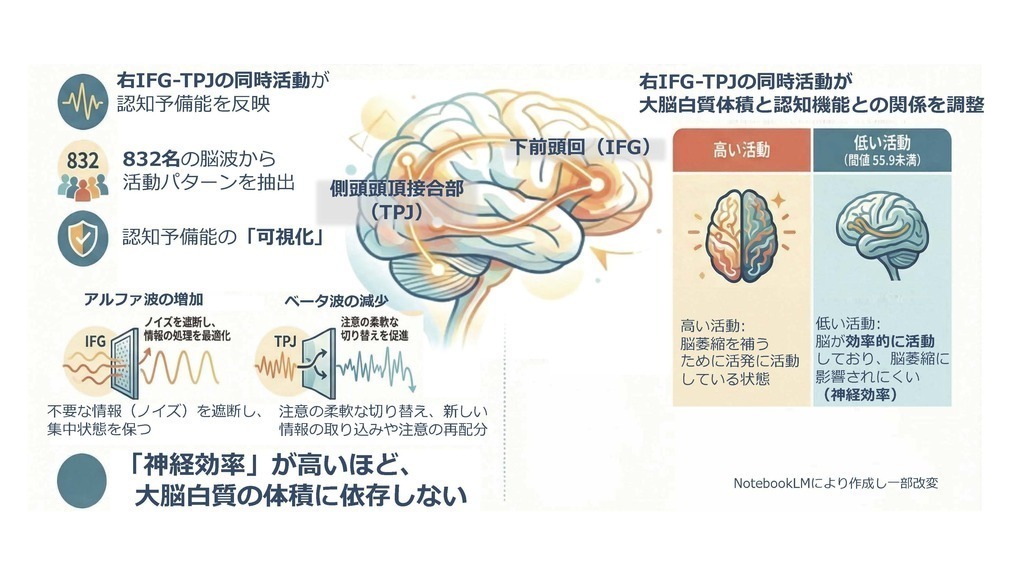
認知予備能を反映した脳の活動パターン
<関連情報>
- https://www.ncgg.go.jp/ri/report/20260331.html
- https://alz-journals.onlinelibrary.wiley.com/doi/10.1002/trc2.70234
白質容積と認知機能の関係を調節する脳ネットワーク Brain networks modulating the relationship between white matter volume and cognition
Osamu Katayama, Ryo Yamaguchi, Daiki Yamagiwa, Shoma Akaida, Takahiro Shimoda, Chika Nakajima, Ayuka Kawakami, Takayuki Kodama, Hiroyuki Shimada
Alzheimer’s & Dementia: Translational Research & Clinical Interventions Published: 19 March 2026
DOI:https://doi.org/10.1002/trc2.70234
Abstract
INTRODUCTION
This study aimed to identify brain networks associated with cognitive reserve (CR), defined as the ability for a higher cognitive performance than would be predicted by white matter volume (WMV), using brain networks derived via electroencephalography (EEG).
METHODS
We used exact low-resolution brain electromagnetic tomography-independent component analysis (eLORETA-ICA) to assess resting-state EEG networks in community-dwelling older adults.
RESULTS
The analysis included 832 individuals. An oscillatory pattern characterized by decreased beta activity in the right temporoparietal junction (TPJ) and increased alpha activity in the right inferior frontal gyrus (IFG) appeared to reflect adaptive, and possibly compensatory, neural processes that help preserve cognitive performance of declining WMV.
DISCUSSION
These findings suggest that specific oscillatory dynamics within the right TPJ–IFG network may reflect adaptive neural mechanisms that help maintain cognitive function in the presence of structural brain decline. Therefore, such measures may serve as potential neurophysiological markers of CR.
Highlights
- Electroencephalography (EEG)-derived networks reveal neural mechanisms underlying cognitive reserve (CR) in aging.
- Decreased beta activity in the temporoparietal junction (TPJ) and increased alpha activity in the inferior frontal gyrus (IFG) support CR.
- TPJ–IFG network activity compensates for white matter volume decline.
- Oscillatory dynamics may serve as neurophysiological markers of CR.