2026-04-24 東京慈恵会医科大学
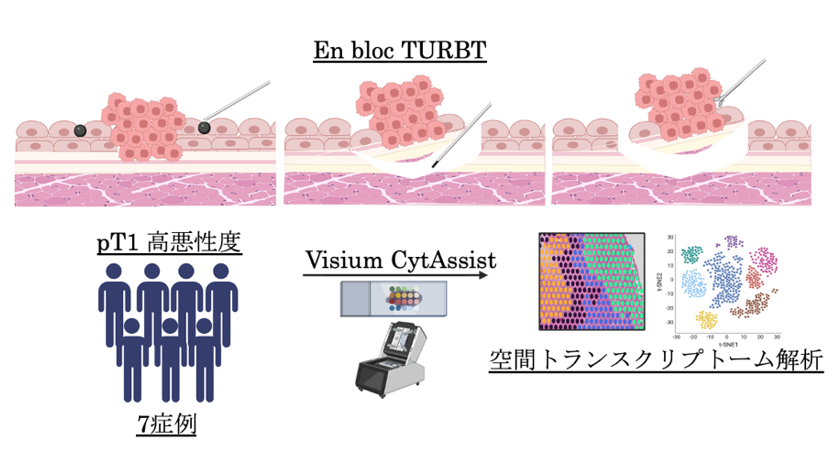
図1 ERBT手順の概略図および空間トランスクリプトームデータ解析ワークフロー
<関連情報>
- https://www.jikei.ac.jp/press/detail/?id=46836
- https://www.jikei.ac.jp/wp-content/uploads/2026/04/【慈恵大学】プレスリリース_膀胱がんの浸潤境界部でがんの進行と予後に関連する遺伝子群を発見.pdf
- https://www.nature.com/articles/s41698-026-01417-x
膀胱腫瘍の一括経尿道切除標本の空間トランスクリプトミクスにより、浸潤前線遺伝子発現シグネチャが定義される Spatial transcriptomics of en bloc transurethral resection of bladder tumor specimens defines an invasive-front gene expression signature
Kentaro Yoshihara,Fumihiko Urabe,Miyaka Umemori,Hironori Suzuki,Kagenori Ito,Takafumi Yanagisawa,Shun Sato,Keisuke Sekine,Takahiro Kimura & Yusuke Yamamoto
npj Precision Oncology Published:14 April 2026
DOI:https://doi.org/10.1038/s41698-026-01417-x Unedited version
Abstract
Bladder cancer is classified by depth of invasion into muscle-invasive bladder cancer (MIBC) and non-muscle-invasive bladder cancer (NMIBC). Because some NMIBC cases progress to MIBC, it is important to elucidate the mechanisms of invasion. Spatial transcriptomics is a powerful tool for characterizing the tumor microenvironment. We applied Visium to seven high-grade NMIBC tumors using en bloc transurethral resection of bladder tumor (ERBT) specimens that preserve three-dimensional tumor architecture. Malignant regions were divided into the tumor-upper and tumor-boundary regions, and seven cases were further stratified by pathological subgroup based on the muscularis mucosae. We identified 15 genes with boundary-enriched expression in the higher-risk subgroup. These genes were enriched for epithelial-mesenchymal transition and myogenesis features. To assess the generalizability of this finding, we analyzed public bulk RNA-seq datasets and found that higher expression of the 15-gene signature was associated with worse overall survival, suggesting potential utility for prognostic stratification and therapeutic decision-making.