2026-05-13 コロンビア大学
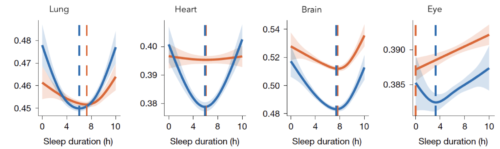
For many organs, sleep duration betwen 6.4 and 7.8 hours was associated with less aging as measured by organ-specific biological clocks. The clocks in this image are created from protein data specific to each organ. Blue lines represent males; red lines represent females. Image from The MULTI Consortium et al. Nature (2026)
<関連情報>
- https://www.cuimc.columbia.edu/news/too-little-sleep-and-too-much-associated-faster-aging
- https://www.nature.com/articles/s41586-026-10524-5
中年期および老年期における生物学的老化時計の睡眠チャート Sleep chart of biological ageing clocks in middle and late life
The MULTI Consortium,Cliodhna Kate O’Toole,Zhiyuan Song,Filippos Anagnostakis,Zhijian Yang,Ye Ella Tian,Michael R. Duggan,Chunrui Zou,Yue Leng,Yi Cai,Wenjia Bai,Cynthia H. Y. Fu,Michael S. Rafii,Paul Aisen,Gao Wang,Philip L. De Jager,Jian Zeng,Hamilton Se-Hwee Oh,Xia Zhou,Keenan A. Walker,Daniel W. Belsky,Andrew Zalesky,Eleanor M. Simonsick,Susan M. Resnick,… Junhao Wen
Nature Published:13 May 2026
DOI:https://doi.org/10.1038/s41586-026-10524-5
Abstract
Optimal sleep has a vital role in promoting healthy ageing and enhancing longevity. Here we propose Sleep Chart to assess the relationship between self-reported sleep duration and 23 biological ageing clocks derived from in vivo imaging1, plasma proteomics2 and metabolomics3. First, a systemic, U-shaped pattern emerges between sleep duration and biological age gaps across nine brain and body systems and three omics technologies. The sample-specific lowest biological age gaps are achieved between 6.4 and 7.8 h of sleep duration, varying by organ and sex in the UK Biobank (aged 37–84 years). Furthermore, short (<6 h) and long (>8 h) sleep duration, compared with a normal sleep duration (6–8 h), are associated with increased risk of systemic diseases beyond the brain and all-cause mortality, with evidence from genetic correlations and time-to-incident survival predictions, such as depression and diabetes. Finally, the pathways by which long and short sleep duration are associated with late-life depression differ: ageing clocks may partially mediate the pathway for long sleep duration, while short sleep duration shows a more direct link. Although Mendelian randomization does not provide strong evidence that disease causally affects sleep, it cannot completely exclude such reverse causality. Our findings suggest a cross-organ, multi-omics U-shaped relationship between sleep duration and biological ageing clocks, highlighting the potential of sleep optimization to promote healthy ageing, lower disease risk and extend longevity.