2026-05-14 中国科学院(CAS)
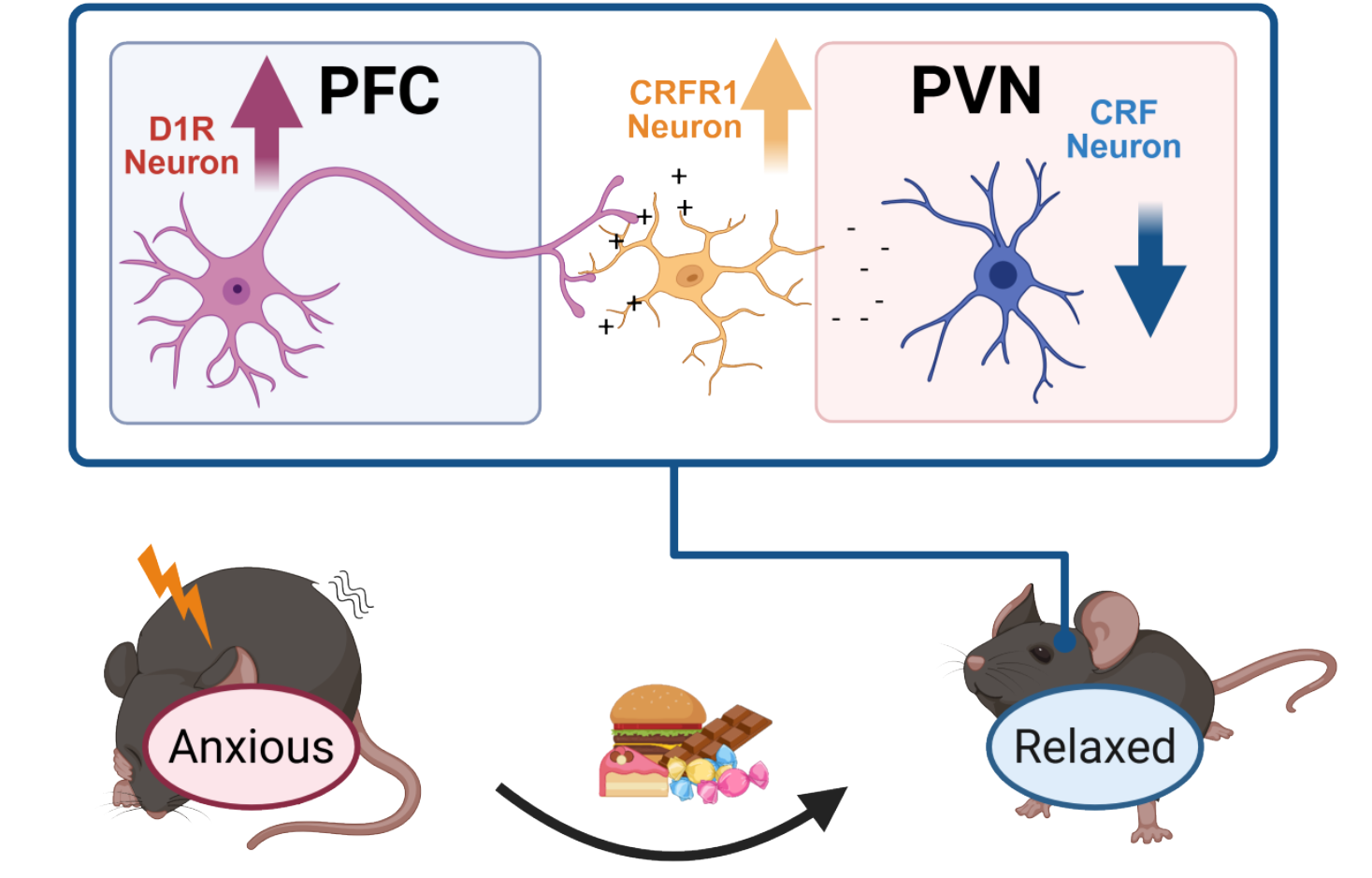
Mechanism of palatable food-driven alleviation of anxiety-like behaviors via the PFCD1R→peri-PVNCRFR1→PVNCRF circuit. (Image by SIAT)
<関連情報>
- https://english.cas.cn/newsroom/research-news/202605/t20260513_1159278.shtml
- https://advanced.onlinelibrary.wiley.com/doi/10.1002/advs.75604
嗜好性の高い食品によって駆動されるトップダウン回路は、PVN周辺CRFR1ニューロンを介してPVN CRF活性を抑制し、ストレスを軽減する Palatable-Food–Driven Top-Down Circuit Inhibits PVNCRF Activity to Mitigate Stress Via Peri-PVNCRFR1 Neurons
Yuchuan Hong, Shirui Jun, Tianjiao Deng, Gaojie Shao, Dan Liu, Yi Sun, Yan Chen, Qian Xiao, Jie Shao, Sheng Wang, Tianwen Huang, Fan Yang, Jie Tu
Advanced Science Published: 10 May 2026
DOI:https://doi.org/10.1002/advs.75604
ABSTRACT
Stress is a major precipitating factor for emotional disorders, including anxiety. To cope with stress, individuals frequently engage in hedonic behaviors, such as eating palatable food, which provide transient relief from psychological distress and may protect against the development of pathology. However, the neural mechanisms by which hedonic experience counteracts stress-induced anxiety remain poorly understood. Here, we identify a neural circuit functionally connecting the prefrontal cortex (PFC) to the paraventricular nucleus (PVN) of the hypothalamus that mediates stress mitigation through palatable food intake. Activation of this circuit suppresses stress-induced hyperactivity of PVN corticotropin-releasing factor (CRF) neurons and prevents the development of anxiety-like behaviors. This effect is driven by palatable-food-induced dopamine release in the PFC, which activates dopamine D1 receptor (D1R)-expressing neurons projecting to corticotropin-releasing factor receptor 1 (CRFR1)-expressing neurons in the PVN and peri-PVN. Notably, GABAergic CRFR1 neurons are enriched in the peri-PVN, with minimal presence within the PVN proper, suggesting that inhibition of PVNCRF neurons is mediated indirectly via peri-PVN GABAergic inputs. These findings define a previously uncharacterized PFC→peri-PVN→PVN circuit through which hedonic experience modulates stress responses and reveal a neural substrate for behavioral resilience, providing a potential avenue for anxiety intervention.