2026-05-15 中国科学院(CAS)
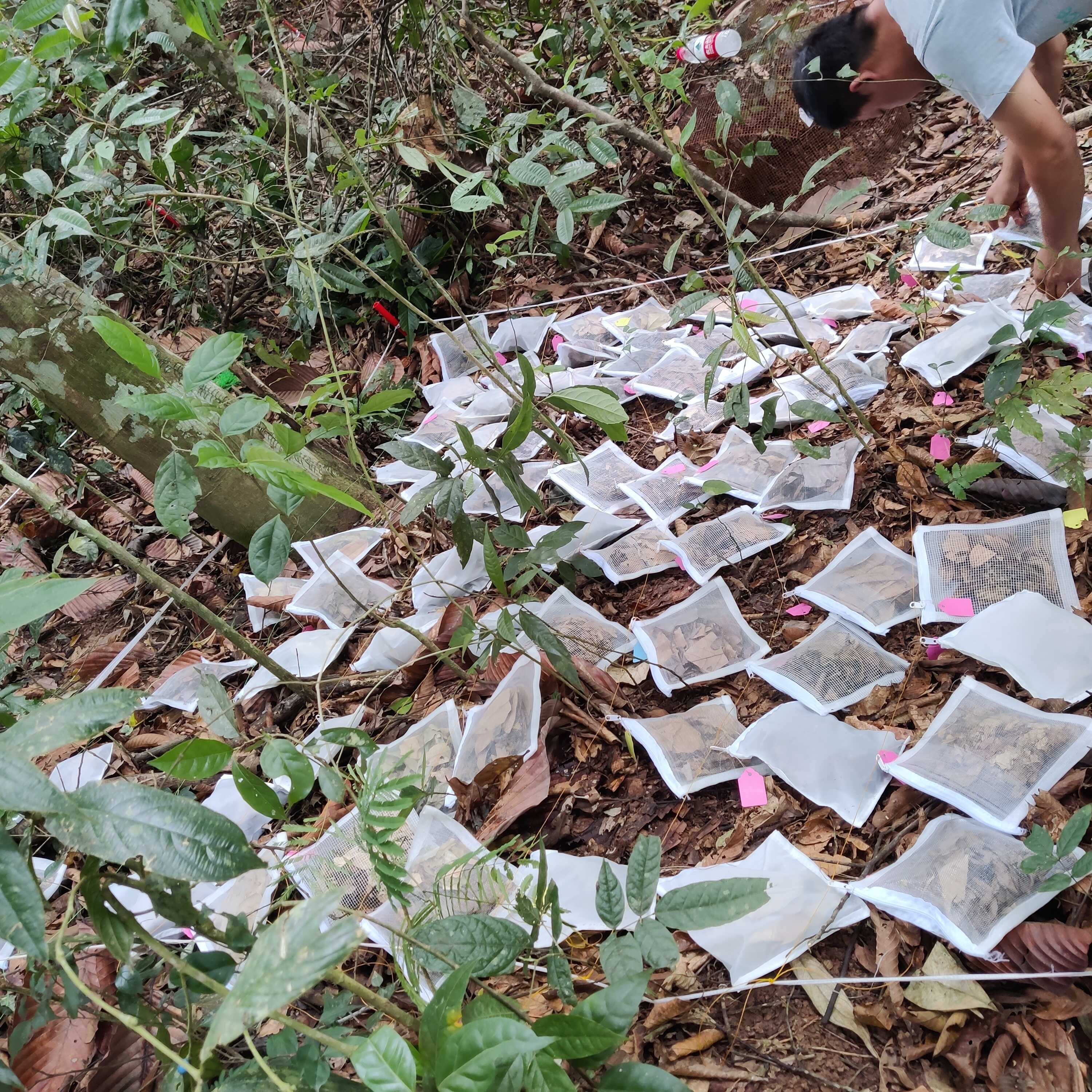
Field experiment testing how different groups of soil fauna interact with litter functional traits to influence mixed-litter decomposition. (Image by Gbadamassi G.O. Dossa)
<関連情報>
- https://english.cas.cn/newsroom/research-news/202605/t20260515_1159455.shtml
- https://www.sciencedirect.com/science/article/abs/pii/S0038071726000829
つる植物と樹木由来の落葉混合物の分解に対する落葉多様性、機能特性、および大型動物相の相互作用効果 Interactive effects of litter diversity, functional traits, and macrofauna on decomposition of litter mixtures from lianas and trees
Denis Mburu Njoroge, Yanlin Zhu, Jean Evans Israel Codjia, Juan Zuo, Gbadamassi G.O. Dossa, Yali Song, Douglas Schaefer, Mareike Roeder, Rhett D. Harrison, Johannes H.C. Cornelissen
Soil Biology and Biochemistry Available online: 17 April 2026
DOI:https://doi.org/10.1016/j.soilbio.2026.110163
Highlights
- Understanding decomposition drivers is vital for global C and nutrient cycles
- Soil fauna size affects their ability to decompose leaf litter
- Litter traits predict mixture decomposition only in the absence of macrofauna
- Initial litter traits do not predict the litter mixing effect
- Macrofauna accelerate decomposition and increase litter mixing effect in tree mixtures
Abstract
Understanding the effect of litter mixing on litter decomposition rates is a prerequisite for predicting global carbon and nutrient cycling. However, the complex interactions associated with the decomposition of litter mixtures hinder their inclusion in global models. Soil fauna play an important role in the decomposition of litter mixtures, and their body size affects their ability to decompose litter. However, how different groups of soil fauna interact with litter traits to drive litter mixture decomposition remains poorly known. Here, through a field leaf litterbag decomposition experiment, we tested how soil fauna size and litter traits affect the decomposition of litter mixtures. We hypothesized that: (H1) The rate of decomposition and the magnitude of the litter mixing effect are greater in the presence of macrofauna. (H2) The effect of litter traits on the litter decomposition rate and the litter mixing effect decreases as the size of soil fauna increases. We used litter from two plant functional groups (trees and lianas) and incubated 27 litter treatments, including 12 single species, six 2-species mixtures, and nine 4-species mixtures. Each litter treatment was incubated using three litterbag mesh size treatments representing access to fauna of increasing body size (0.07 mm, 2.0 mm, and 5.0 mm) for 365 days. Both H1 and H2 were only partially supported. Macrofauna access accelerated decomposition and increased the litter mixing effect for tree-only mixtures. Initial litter traits predicted mixture decomposition rates in the presence of microbes and mesofauna, but not in the presence of macrofauna. Surprisingly, initial traits did not predict the litter mixing effect. This study highlights that litter traits may vary in their importance to different groups of soil fauna. In nature, therefore, where fauna communities (micro-, meso-, and macro-fauna) co-occur, and litter mixtures vary spatially, it may be difficult to predict decomposition rates.