2026-05-19 中国科学院(CAS)
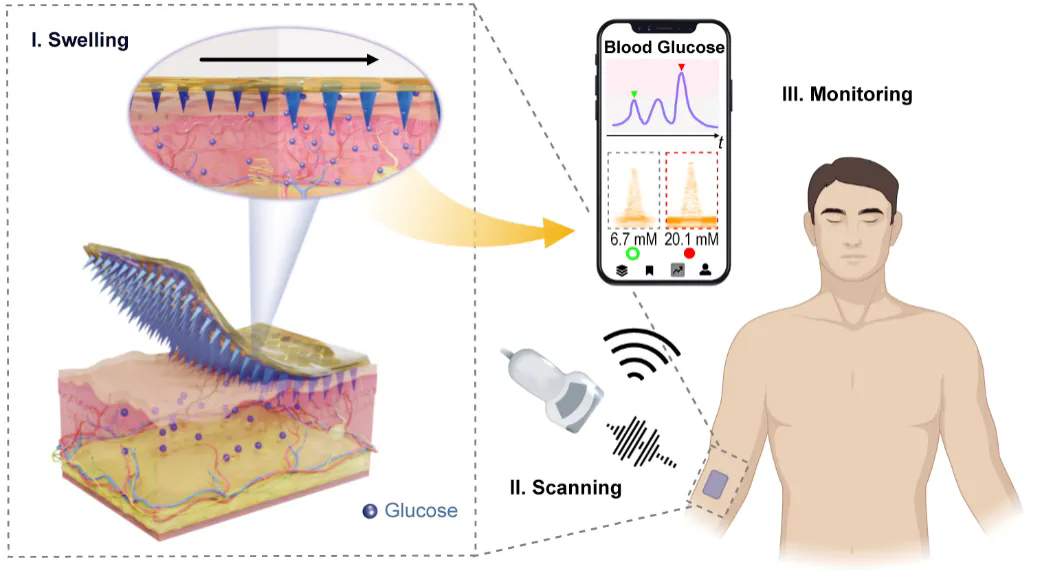
Schematic diagram of a continuous glucose monitoring system using a standard ultrasound probe combined with the developed ARMPatch, and a schematic diagram of the glucose-responsive mechanism of the synthetic hydrogel under glucose regulation. (Image by SIAT)
<関連情報>
- https://english.cas.cn/newsroom/research-news/202605/t20260519_1159607.shtml
- https://www.science.org/doi/10.1126/sciadv.aec3209
装着可能な音響読み取り式マイクロニードルパッチによる超音波を用いた連続血糖モニタリング Augmenting ultrasound for continuous glucose monitoring via a wearable acoustically readable microneedle patch
Wanglinhan Zhang, Jiangang Xu, Xinjia Li, Yeji Jang, […] , and Zhongqing Su
Science Advances Published:1 May 2026
DOI:https://doi.org/10.1126/sciadv.aec3209
Abstract
Continuous glucose monitoring (CGM) represents substantial advancement, yet poses a challenge in wearable health care development. Current enzymatic CGM faces limitations in stability, cost, and durability. We introduce an enzyme-free, wearable acoustically readable microneedle patch (ARMPatch) composed of glucose-responsive hydrogel. Positioned between a standard ultrasound probe and the skin, ARMPatch acts as an acoustic interface enabling CGM using conventional ultrasound. Its hydrogel microneedles minimally penetrate the epidermis, allowing interstitial fluid to trigger variable swelling of the microneedles in response to glucose fluctuations. ARMPatch delivers stable and selective glucose readings for up to 56 days. Glucose variations with millimolar resolution are obtained via ultrasound within a response time of 30 to 60 minutes. In vivo CGM in animal models for 7 days reveals a reversible correlation between microneedle swelling and glucose variations. Acting as “accessory” for standard ultrasound probes, this approach offers a minimally invasive, cost-effective, and long-lasting solution to non-enzymatic CGM, expanding the utility of ultrasound in wearable biosensing.