2026-05-21 コペンハーゲン大学
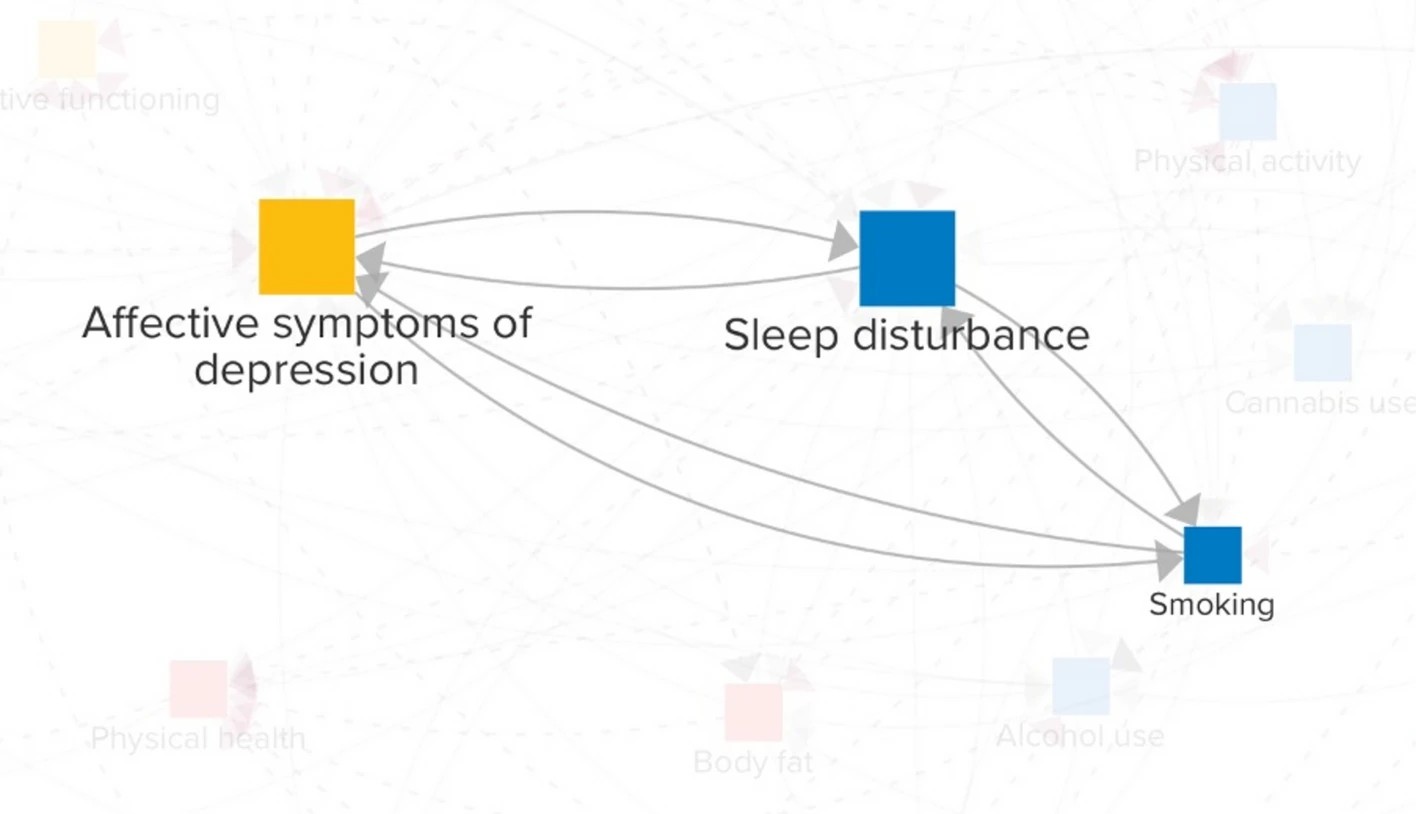
Illustration of ‘vicious cycle’ between smoking, sleep and symptoms of depression. Illustration from new study.
<関連情報>
- https://news.ku.dk/all_news/2026/05/why-are-young-peoples-sleep-and-mental-health-so-poor-researchers-point-to-vicious-cycles-as-possible-explanation/
- https://link.springer.com/article/10.1186/s12916-026-04738-7
若年成人の睡眠モデル:メンタルヘルスの動態に関する進化する因果ループ図 The Young Adult Sleep model: an evolving causal loop diagram of mental health dynamics
Jeroen F. Uleman,Rushd F. M. Al-Shama,Adrian G. Zucco,Jette Echterhoff,Maartje Luijten,Maaike Verhagen,Jana Vyrastekova,Jorien L. Treur,Robyn E. Wootton,Sicelo Jones,Martin Dresler,Henning J. Drews,Christine Egebjerg,Birgitte R. Kornum,Karien Stronks & Naja Hulvej Rod
BMC Medicine Published:16 March 2026
DOI:https://doi.org/10.1186/s12916-026-04738-7
Abstract
Background
This study introduces the Young Adult Sleep model, a comprehensive causal loop diagram (CLD) developed to explore the dynamic feedback mechanisms underlying sleep problems and affective depressive symptoms in young adults—an urgent public health challenge.
Methods
The CLDs was developed through five asynchronous questionnaire-based assignments completed by a panel of 14 domain experts, two existing CLDs, and targeted reviews of the scientific literature. Natural language processing was used to curate the system variables from questionnaire data.
Results
The CLD integrates extensively interconnected variables across biological, psychological, behavioral, and social domains. It comprises 29 variables and 175 causal connections, forming numerous reinforcing feedback loops that can drive “vicious” cycles, such as the interplay of sleep disturbances and affective depressive symptoms with addictive behaviors like smoking. The experts also identified balancing loops that may counteract these self-reinforcing dynamics. Many loops span multiple domains, underscoring the importance of multidomain interventions and of interdisciplinary research that synthesizes evidence across scientific fields.
Conclusions
The Young Adult Sleep model is an evolving CLD framework that is intended to be further refined as new evidence becomes available. It supports iterative theory development and hypothesis generation, and serves as a foundation for future computational modeling to simulate intervention strategies to address this complex public health problem.