2026-05-22 東京大学
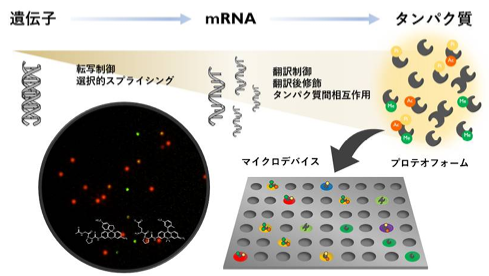
タンパク質の機能を1分子レベルで解析する方法論に基づく次世代疾患診断プラットフォームの概念。セントラルドグマの中でタンパク質は多様な個性(プロテオフォーム)を獲得する。1分子レベルのタンパク質の活性を個別に評価することで、プロテオフォームごとの異なる活性を評価することを可能とする。
<関連情報>
- https://www.u-tokyo.ac.jp/focus/ja/press/z0111_00067.html
- https://www.u-tokyo.ac.jp/content/400288233.pdf
- https://www.cell.com/cell-biomaterials/fulltext/S3050-5623(26)00112-1
循環プロテオフォームシグネチャーの疾患関連変化を解明するための単一分子プロテアーゼ活性解析プラットフォームの開発 Development of a single-molecule protease activity analysis platform to elucidate disease-related alterations of circulating proteoform signatures
Shingo Sakamoto ∙ Hideto Hiraide ∙ Tadahaya Mizuno ∙ … ∙ Rikiya Watanabe ∙ Yasuteru Urano ∙ Toru Komatsu
Cell Biomaterials Published: May 21, 2026
DOI:https://doi.org/10.1016/j.celbio.2026.100456
The bigger picture
The accurate detection of early-stage pancreatic ductal adenocarcinoma (PDAC) remains one of the most formidable challenges in clinical oncology. Conventional protein biomarkers, such as CA19-9, often lack the sensitivity and specificity required for early diagnosis. Although various protein-based biomarkers are being developed, assays that primarily measure total protein concentration often lack functional relevance and proteoform-level resolution.
In this study, we present an analytical framework that measures the function of individual protein molecules by combining multicolor single-molecule enzyme activity profiling (SEAP) with deep learning-based data interpretation. By digitizing the activity of individual enzyme molecules in clinical blood samples, our platform resolves previously indistinguishable “proteoform signatures”—unique functional fingerprints associated with specific disease states.
Using this approach, we identified distinct activity patterns of circulating DPP4, FAPα, and CD13 that are associated with early-stage PDAC. The integration of mass-producible cyclic olefin polymer (COP) microdevices enhances the platform’s compatibility with existing clinical diagnostic infrastructures. Overall, this work moves beyond simple biomarker discovery by enabling high-dimensional functional profiling of circulating proteases. It opens new opportunities for early cancer detection and for the development of personalized therapeutic strategies based on the functional landscape of the blood proteome at single-molecule resolution.
Highlights
- Single-molecule platform reveals protease activity heterogeneity in blood
- Microdevice-based assay enables direct activity analysis of circulating proteoforms
- Deep learning extracts disease-associated enzyme activity signatures
- Activity-based proteoform profiling enables high-dimensional biomarker discovery
Summary
Protein function represents an important output of biological regulation, yet its direct measurement in circulation has been hindered by limited sensitivity and the inability to discriminate among different proteoforms. We developed scaffolds for single-molecule enzyme activity analysis probes that can resolve functional proteoforms of proteases/peptidases in blood samples. The single-molecule assay uncovered multiple proteoforms of dipeptidyl peptidase 4 (DPP4)/fibroblast activating protein α (FAPα) complexes and aminopeptidase N (CD13) with altered activity patterns in blood samples of pancreatic ductal adenocarcinoma (PDAC) patients. These findings serve as a proof of concept for functional proteoform discovery in complex biofluids and lead to a better understanding of how the remodeled tumor microenvironment imprints functional enzyme signatures in circulation.