2026-05-26 中国科学院(CAS)
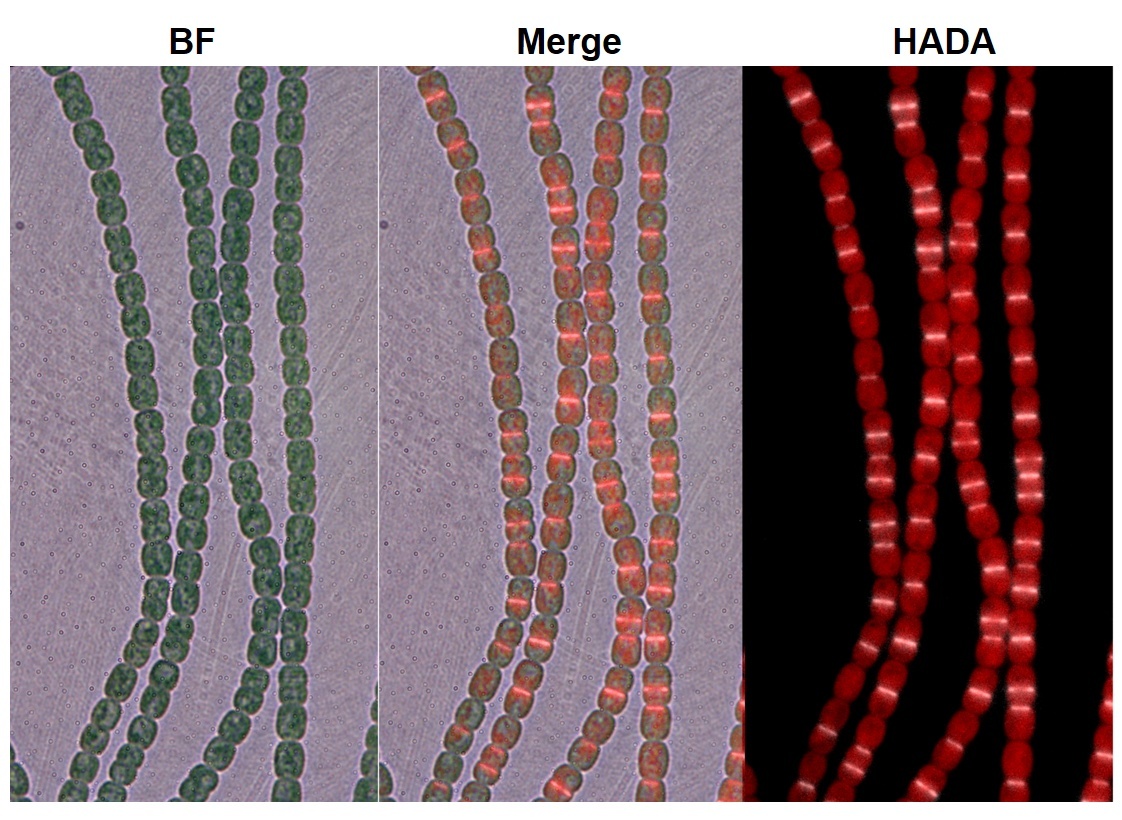
Cell size and cell fate regulation of a cyanobacterium (Image by IHB)
<関連情報>
- https://english.cas.cn/newsroom/research-news/202605/t20260526_1159948.shtml
- https://journals.plos.org/plosbiology/article?id=10.1371/journal.pbio.3003750
複数のc-di-GMP代謝酵素に依存する二重閾値システムがシアノバクテリアの細胞運命を制御する A dual-threshold system relying on multiple c-di-GMP metabolic enzymes controls cell fate of a cyanobacterium
Qing-Xue Sun,Min Huang,Yiling Yang,Xiaoli Zeng ,Cheng-Cai Zhang
PLOS Biology Published: April 8, 2026
DOI:https://doi.org/10.1371/journal.pbio.3003750
Abstract
Cyclic-di-GMP (c-di-GMP) is a ubiquitous second messenger in bacteria and regulates a variety of cell activities. Many bacteria contain multiple enzymes involved in c-di-GMP synthesis or degradation; however, how they coordinate with each other to orchestrate c-di-GMP homeostasis remains unclear. Here, using the cyanobacterium Anabaena PCC 7120 as a model, we created cdG0 and cdGmax strains by deleting all 8 and 14 genes, respectively, that encode enzymes with c-di-GMP degradation and synthesis domains, alongside a collection of mutants with various numbers of these genes deleted. Our findings demonstrate that c-di-GMP in Anabaena not only modulates cell size but is also indispensable for cell viability. Quantitative analysis established two critical physiological thresholds in vivo: a minimal c-di-GMP level required for cell size maintenance and a lower, lethal threshold essential for survival. We show that the 16 enzymes involved in c-di-GMP turnover in Anabaena function as an electromechanical-like dual relay to control c-di-GMP dynamics, with different modules contributing to c-di-GMP homeostasis or responding as an SOS alarm when the c-di-GMP concentration drops below the lethal threshold. Both effects of c-di-GMP on cell size reduction and cell viability are mediated by the cyclic-di-GMP receptor (CdgR), depending on the amount of the c-di-GMP-free form of CdgR available because of titration by c-di-GMP in the cells. The system, with the two concentration thresholds of c-di-GMP that dictate cell size and viability, respectively, enables dynamic cellular adaptation while preventing lethal effects.