2026-06-15 国立精神・神経研究医療センター,理化学研究所
<関連情報>
- https://www.ncnp.go.jp/topics/detail.php?@uid=AwDUBs1bDTj2Rx4B
- https://rupress.org/jcb/article-abstract/225/8/e202509200/282733/Redox-dependent-S-glutathionylation-of-Aurora-A
GstpによるオーロラAキナーゼの 酸化還元依存性S-グルタチオン化はシナプス後部の成熟を促進する
Redox-dependent S-glutathionylation of Aurora-A kinase by Gstp promotes postsynaptic maturation
Shuji Wakatsuki ,Akiko Yumoto,Takehiro Suzuki,Naoshi Dohmae,Toshiyuki Araki
Journal of Cell biology Published:June 12 2026
DOI:https://doi.org/10.1083/jcb.202509200
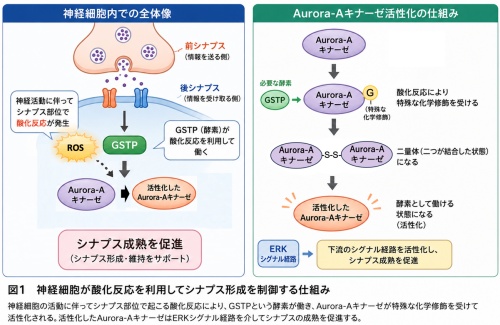
Synapse formation relies on the precise orchestration of signaling pathways within postsynaptic compartments. Although we previously identified Aurora-A kinase as a promoter of synaptogenesis, the mechanism by which it is activated in postmitotic neurons lacking canonical cell cycle cofactors has remained elusive. Here, we identify a neuron-specific regulatory mechanism in which Pi-class glutathione S-transferase catalyzes S-glutathionylation of Aurora-A at C290 in response to localized redox fluctuations. This priming event catalytically promotes Aurora-A dimerization and subsequent autophosphorylation at T288, thereby enhancing kinase activity independently of classical mitotic activators. Activated Aurora-A then phosphorylates major vault protein at S563 and S585, destabilizing the vault complex and initiating local MEK/extracellular signal-regulated kinase signaling, which drives synaptogenesis. Together, these findings define a Gstp–Aurora-A–Mvp signaling axis that links localized redox dynamics to synaptic maturation and illustrates how neurons repurpose potent mitotic machinery through precise catalytic redox regulation, with significant implications for understanding kinase dysregulation in neurodevelopmental and neurodegenerative disorders associated with oxidative stress.