20026-06-15 東京農工大学
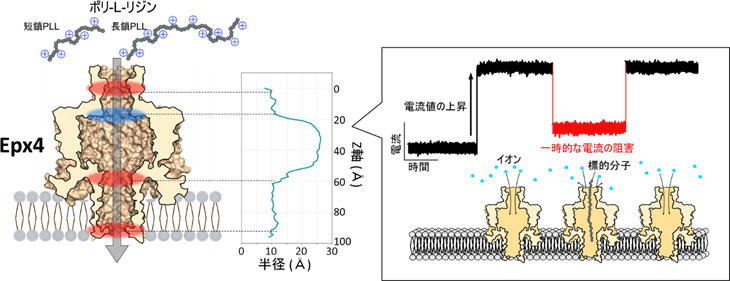
図1:Epx4ナノポアの構造とナノポア計測の原理。(A. Ijuin et al., Small Methods, 2026より一部引用)
<関連情報>
- https://www.tuat.ac.jp/outline/disclosure/pressrelease/2026/20260615_01.html
- https://onlinelibrary.wiley.com/doi/10.1002/smtd.70762
単一分子識別のための複数の狭窄部を有するEpx4ナノポア Epx4 Nanopore With Multiple Constrictions for Single-Molecule Identification
Ayako Ijuin, Kota Naito, Mana Sato, Virginia Di Toro Mammarella, Nanami Takeuchi, Mauro Chinappi, Yoshikazu Tanaka, Ryuji Kawano
Small Methods Published: 11 June 2026
DOI:https://doi.org/10.1002/smtd.70762
ABSTRACT
Nanopore technology enables rapid, portable, and label-free single-molecule detection of analytes, including nucleic acids and proteins. One strategy for improving accuracy is to increase interactions between analytes and the nanopore. For example, engineered nanopores with additional constrictions improve analyte-pore interactions during translocation. This concept adopts the exploration of biological nanopores, which naturally contain multiple constrictions. Here, we demonstrate that Epx4, a pore-forming toxin with two independent β-barrels, functions as a nanopore sensor capable of generating informative ionic current signals during polypeptide translocation. Structural analysis of the pore geometry revealed that Epx4 contains up to four constrictions. In single-molecule measurements, Epx4 detected cationic polypeptides with a higher event frequency than α-hemolysin (αHL). With machine-learning-assisted analysis, Epx4 achieved an ROC AUC score of 0.82 and an F1 score of 0.72, both of which were higher than those obtained with αHL. Our findings suggest that Epx4 is a promising candidate for developing nanopore sensors with high accuracy for protein analysis.