
2026-06-12 中国科学院(CAS)
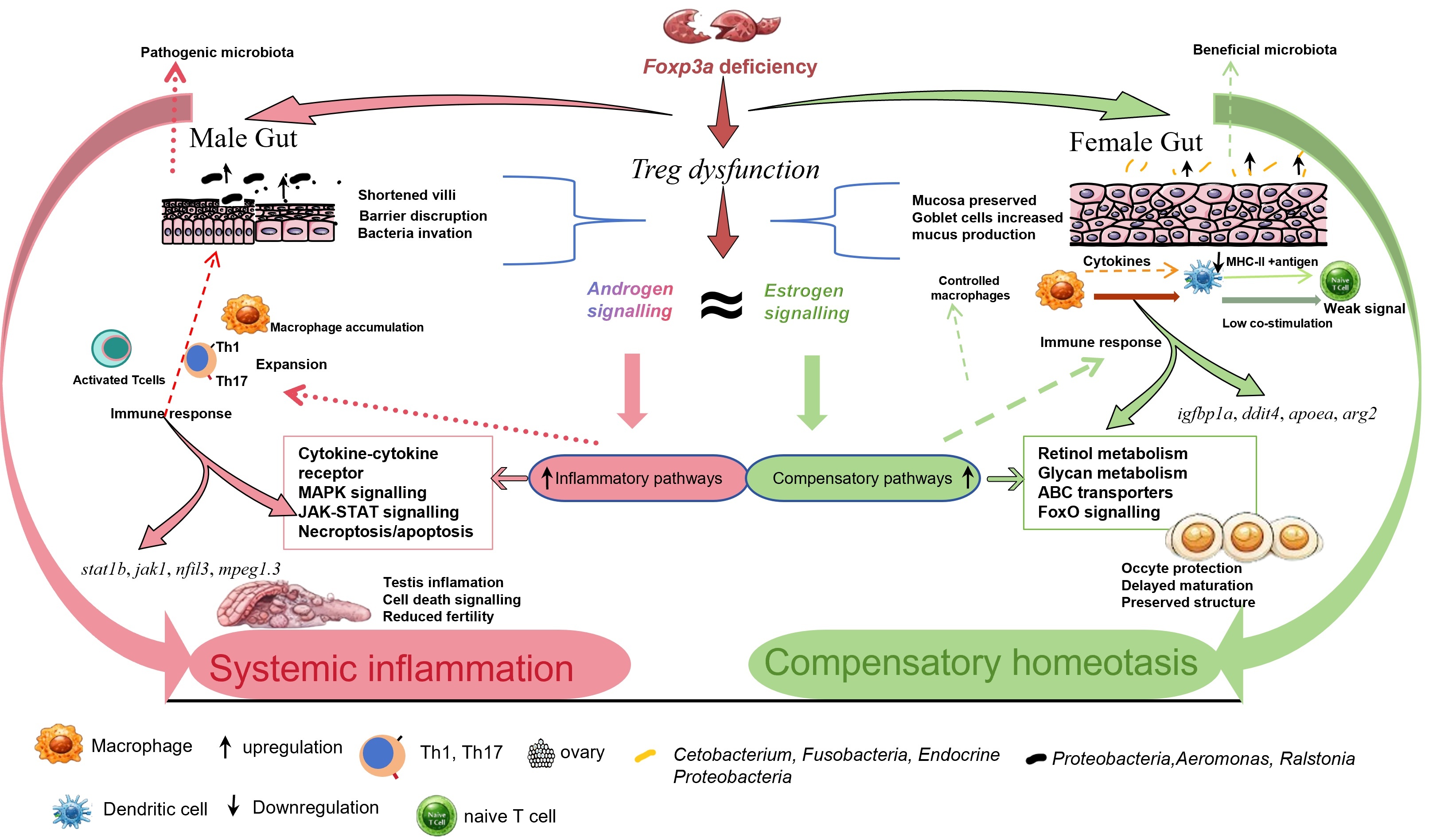
Sex dimorphism in foxp3a-mediated immune regulation and associated metabolic processes along the gut-liver-gonad axis. (Image by IHB)
<関連情報>
- https://english.cas.cn/newsroom/research-news/202606/t20260612_1163500.shtml
- https://www.sciencedirect.com/science/article/abs/pii/S1050464826003657
ゼブラフィッシュにおいて、 foxp3aの欠損は腸-肝臓-生殖腺軸全体にわたる性特異的な免疫代謝リモデリングを引き起こす Loss of foxp3a drives sex-specific immune-metabolic remodeling across the gut-liver-gonad axis in zebrafish
Yuhang Hu, Deinyefa Godfree Igbiriki, Nan Wu, Jialin Li, Junheng Liu, Jiuwu Yin, Jinping Duan, Xianmei Li, Zhixian Qiao, Feng Xiong, Yingyin Cheng, Wanting Zhang, Jorge Galindo-Villegas, Yaping Wang, Xiao-Qin Xia
Fish & Shellfish Immunology Available online: 28 May 2026
DOI:https://doi.org/10.1016/j.fsi.2026.111461
Highlights
- Loss of foxp3a is associated with sex-dependent immune regulation in zebrafish.
- Male foxp3a−/− zebrafish display enhanced inflammation across gut-liver-gonad axis.
- Female foxp3a−/− zebrafish show compensatory metabolic and microbiota shifts.
- Gender-biased foxp3a links immune imbalance with metabolic and reproductive outcomes.
Abstract
Sex differences are a basic but still underexplored feature of mucosal immune regulation. Forkhead box P3 (FOXP3) is a key regulator of regulatory T cell (Treg) function, but how its activity differs between sexes and across organs remains unclear. Here, we identify foxp3a as the functional zebrafish homolog of mammalian FOXP3 and use a foxp3a-deficient zebrafish model to examine how immune and metabolic processes are coordinated along the gut-liver-gonad axis. Loss of foxp3a was associated with clear sex- and age-dependent changes in intestinal structure and immune composition, including epithelial barrier damage, altered goblet cell patterns, and increased immune cell infiltration. Transcriptomic analyses showed sustained activation of innate immune and inflammatory pathways in males, while females showed a more transient immune response together with metabolic pathway enrichment, suggesting compensatory regulation. Similar sex-biased patterns were observed in extraintestinal organs. The liver showed ongoing metabolic disruption, while the gonads displayed delayed ovarian development and inflammatory and stress-associated signatures in the testis. Single-cell RNA sequencing of intestinal mucosal cells revealed sex-specific immune remodeling, including reduced Treg populations and expansion of Th1 and Th17 cells, alongside distinct immune-metabolic gene programs across cell types. Deficiency of foxp3a was also linked to progressive, sex-dependent changes in gut microbiota composition and predicted microbial functions. Integrated multi-omics analyses support a model in which foxp3a contributes to sex-biased coordination of immune, metabolic, and reproductive processes across organs. Together, these findings position foxp3a as a key factor in sexually dimorphic mucosal immune regulation and highlight zebrafish as a useful system for studying sex-specific immune dysfunction.

