2026-06-04 大阪大学
<関連情報>
- https://www.dent.osaka-u.ac.jp/20260604/18643
- https://link.springer.com/article/10.1007/s12105-026-01921-3
口腔癌クニクラタムとその組織学的類似疾患の遺伝学的特徴 Genetic Landscape of Oral Carcinoma Cuniculatum and its Histological Mimics
Sawako Ono,Yuki Fukawa,Katsutoshi Hirose,Yumiko Hori,Daisuke Motooka,Hiroyuki Harada,Eiichi Morii,Satoru Toyosawa,Naozumi Ishimaru & Hidetaka Yamamoto
Head and Neck Pathology Published:25 May 2026
DOI:https://doi.org/10.1007/s12105-026-01921-3
Abstract
Purpose
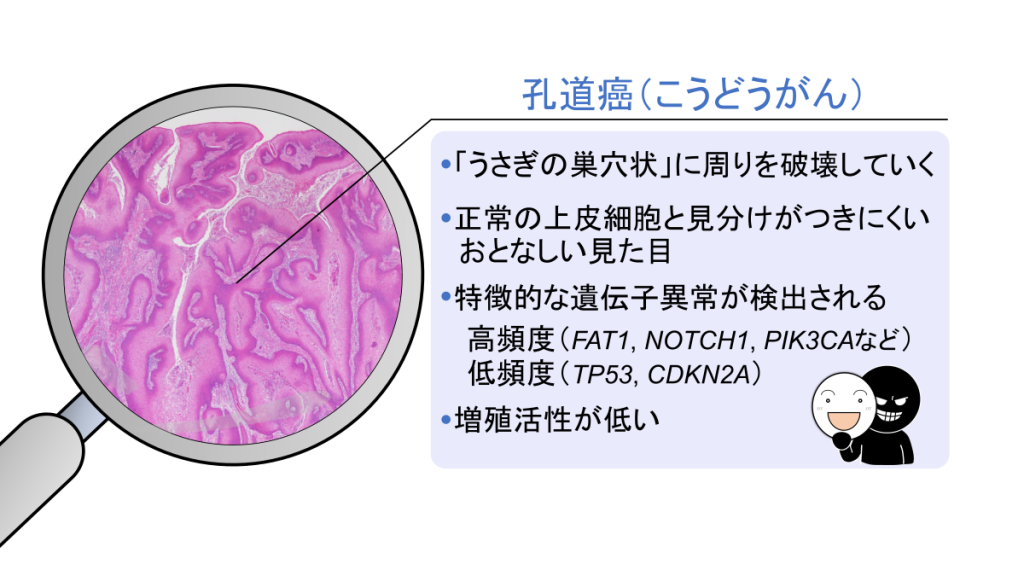
Oral carcinoma cuniculatum (CC) is a rare variant of oral squamous cell carcinoma (OSCC), characterized by a well-differentiated, burrowing invasive pattern and minimal cellular atypia. Its diagnosis is challenging owing to its bland morphology, which makes differentiation from non-neoplastic lesions difficult on biopsy. Despite this, CC often requires distinction from conventional OSCC, even in surgical specimens. Histological overlap with conventional OSCC suggests a continuous spectrum of diseases. To clarify the genetic identity of pure CC, we analyzed 23 cases of OSCC with burrowing invasive patterns and classified them into three groups: CC, conventional OSCC (SCC), and uncertain CC (UCC).
Methods
We retrospectively reviewed 2002 OSCC cases from multicenter archives. From this cohort, 23 cases exhibiting a burrowing invasive pattern characteristic of CC were selected. The cases were classified into the three study groups based on the WHO diagnostic criteria, and clinicopathological features were reviewed. Targeted next-generation sequencing was performed to identify clinically significant genetic alterations, and immunohistochemical staining was also conducted.
Results
The 23 cases were histologically classified into CC (n = 8), UCC (n = 7), and SCC (n = 8) groups. Clinically, the CC group predominantly affected the gingiva with no recurrence or metastasis. Conversely, the SCC group primarily involved the tongue and showed recurrence and metastasis. Genetic alterations were detected in 87.5% (7/8) of CC cases, with low frequencies of TP53 (12.5%) and CDKN2A (25.0%) alterations and higher frequencies of FAT1 (50.0%), NOTCH1 (37.5%), PIK3CA (37.5%), and CASP8 (50.0%) alterations. In contrast, the SCC group showed frequent TP53 (75.0%) and CDKN2A (75.0%) alterations, whereas FAT1 and NOTCH1 alterations were absent. Consistent with these findings, p53 staining revealed wild-type patterns in the CC group along with a lower Ki-67 labeling index. The UCC group exhibited intermediate clinicopathological and genetic characteristics.
Conclusion
This study provides the first genetic characterization of oral CC, distinct from that of conventional OSCC. This genetic signature may contribute to the biological behavior of CC and offer a potential tool for its differential diagnosis. Further studies with larger cohorts are required to confirm the relationship between CC and conventional OSCC, and to fully elucidate the genetic landscape of CC.