2026-06-12 東京科学大学
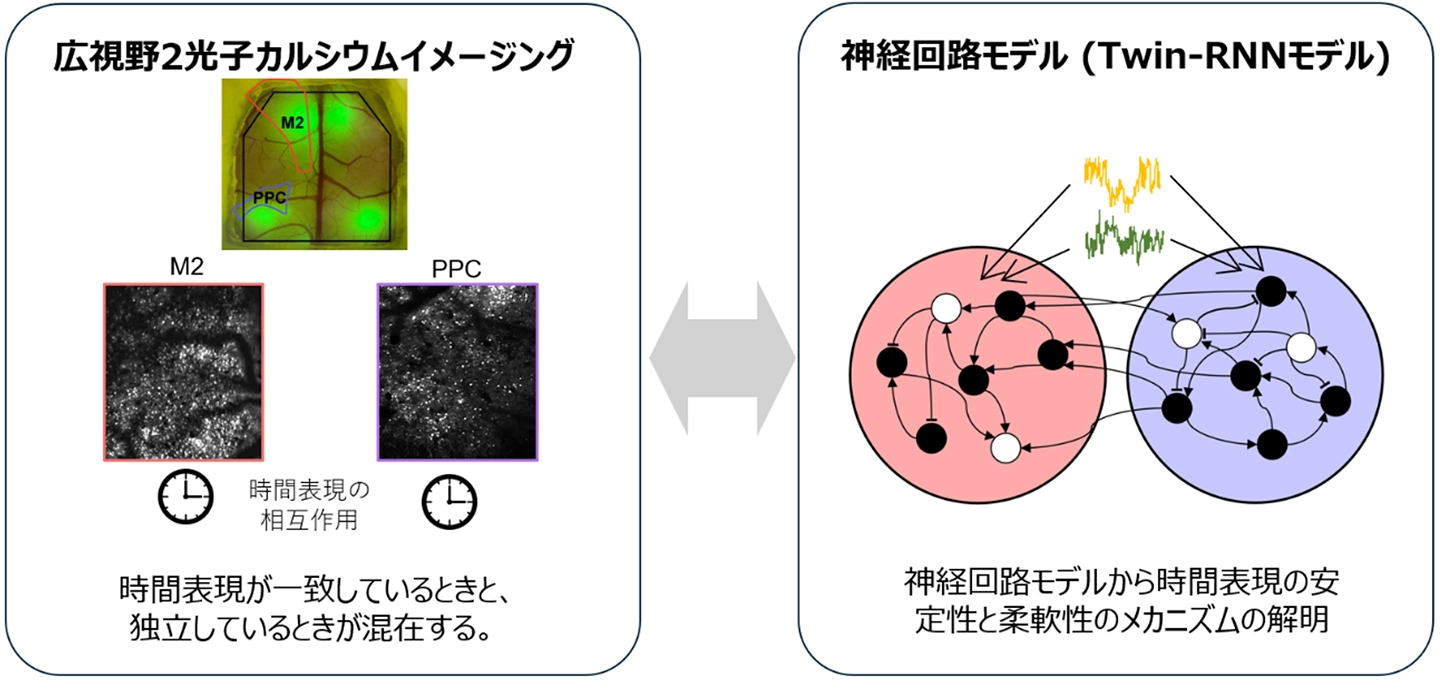
図1. 左は、大規模二光子カルシウムイメージングにより、マウス大脳皮質の複数領域から多数の神経細胞活動を同時に記録した画像です。右は、実験で観察された脳領域間の時間情報処理を理解するために構築したTwin-RNNモデルを示しています。2つのネットワークをまばらに結合することで、脳領域どうしが時間情報を共有しながらも、必要に応じてそれぞれが独立して働く仕組みを検証しました。
<関連情報>
前頭頭頂ネットワークにおける時間的シーケンス計算の独立性と一貫性 Independence and coherence in temporal sequence computation across the fronto-parietal network
Hiroto Imamura,Fumiya Imamura,Reiko Hira,Yoshikazu Isomura & Riichiro Hira
Nature Communications Published:11 June 2026
DOI:https://doi.org/10.1038/s41467-026-73999-w
Abstract
Time processing requires distributed and coordinated cortical dynamics, yet how multiple brain areas flexibly switch between coherent and independent temporal representations remains unclear. Using mesoscale two-photon calcium imaging, we simultaneously recorded neuronal populations in the secondary motor cortex and posterior parietal cortex of mice performing a novel alternating-interval timing task. Both areas encoded elapsed time through similar high-dimensional sequential activity, and decoding analyses revealed both coherent temporal errors shared across areas and independent errors confined to one area. Communication-subspace analysis showed that temporal information was distributed across multiple low-variance shared dimensions, whereas the dominant shared dimension preferentially encoded behaviour. A twin recurrent neural network model with sparse inter-network coupling and shared high-variance noise reproduced these experimental findings. Perturbation and local Lyapunov exponent analyses further showed that different shared subspaces selectively promote coherent or independent modes. These results reveal how sparse coupling and shared global fluctuations enable robust yet flexible fronto-parietal temporal computation.