
2026-06-22 合肥物質科学研究院(HFIPS)
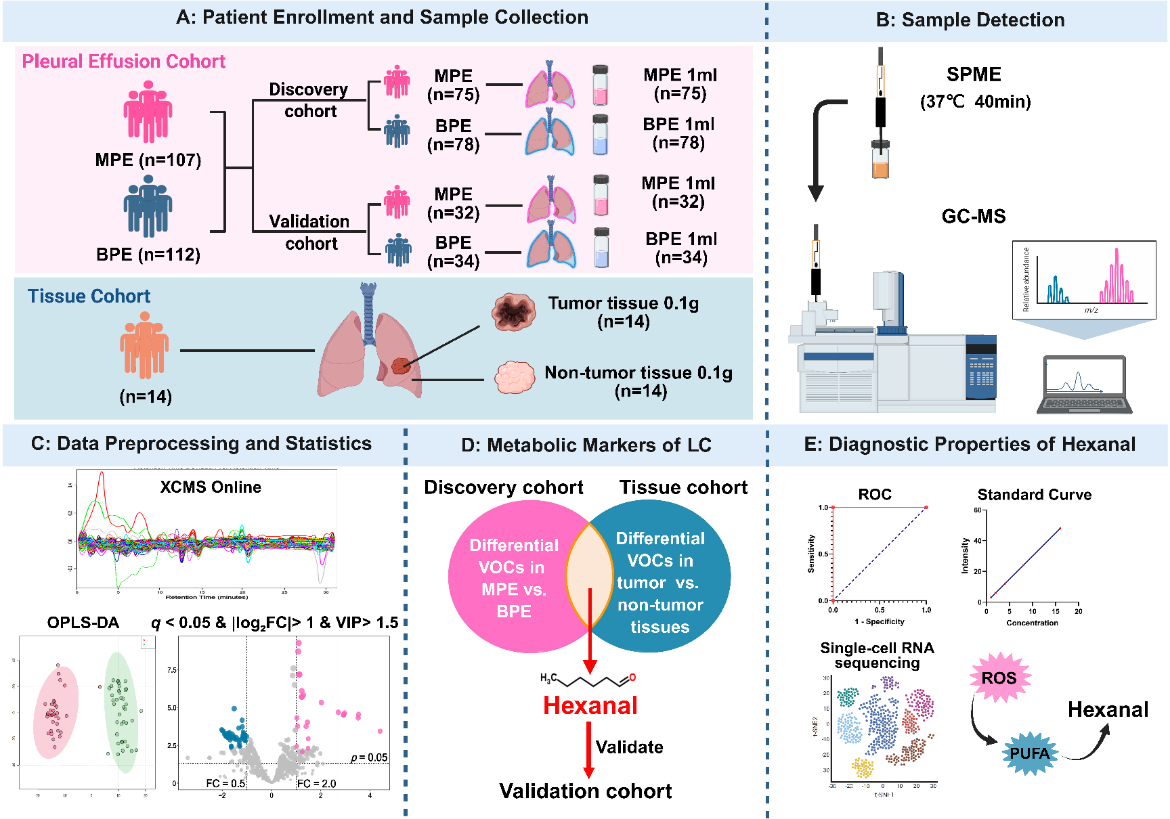
Gas chromatography–mass spectrometry-based “gas biopsy” workflow (Image by WANG Hongzhi)
<関連情報>
- https://english.hf.cas.cn/nr/bth/202606/t20260622_1174350.html
- https://onlinelibrary.wiley.com/doi/10.1002/mco2.70787
質量分析法による胸水ガス生検を用いた肺癌診断 Gas Biopsy of Pleural Effusion to Diagnose Lung Cancer by Mass Spectrometry
Wenting Liu, Jian Qi, Yajing Chu, Jijuan Zhou, Yue Liu, Li Ke, Xiangxue Zheng, Yan Lu, Dianlong Ge, Yannan Chu, Hongzhi Wang
MedComm Published: 04 June 2026
DOI:https://doi.org/10.1002/mco2.70787
ABSTRACT
Lung cancer (LC) is a leading cause of cancer mortality worldwide, frequently complicated by malignant pleural effusion (MPE). This study aimed to investigate volatile organic compounds (VOCs) in pleural effusion to identify metabolic biomarkers for LC. A total of 107 LC-related MPE and 112 benign pleural effusion (BPE) patients were enrolled and divided into discovery (MPE: n = 75; BPE: n = 78) and validation (MPE: n = 32; BPE: n = 34) cohorts. Paired tumor and adjacent nontumor tissues from 14 LC patients formed an independent cohort. Differential VOCs were identified using criteria of q < 0.05, |log2 fold change| > 1, and VIP > 1.5 in both the pleural effusion discovery cohort and the tissue cohort. Hexanal was identified as the only LC-associated VOC present across both compartments. In the validation cohort, hexanal demonstrated strong diagnostic performance in distinguishing MPE from BPE (AUC = 0.8339; sensitivity 75.00%; specificity 65.71%). Single-cell analysis indicated that hexanal accumulation is linked to fatty acid metabolism reprogramming. This study supports pleural effusion-based gas biopsy as a promising LC diagnostic approach.

