2026-06-22 東京科学大学
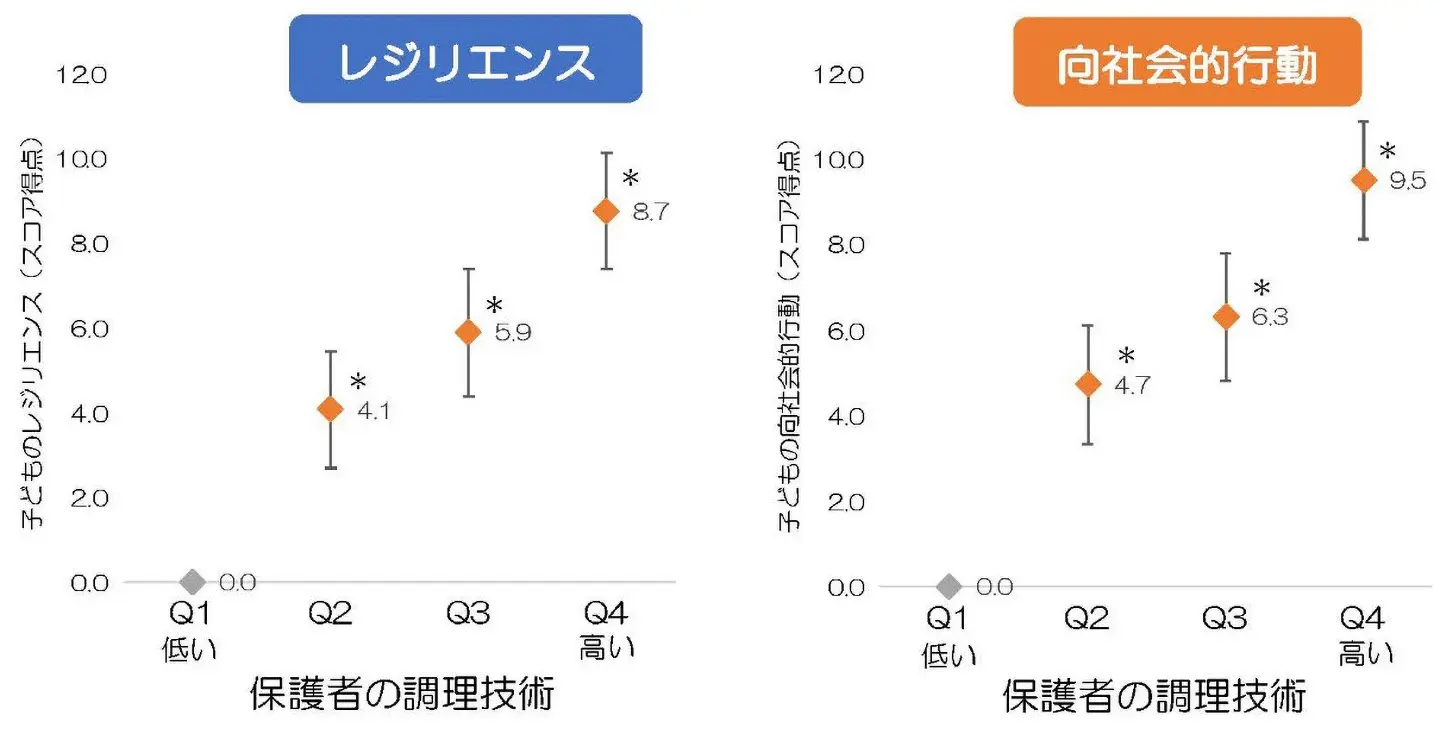
図1. 保護者の調理技術と子どものレジリエンス/向社会的行動
調整した項目:子どもの性別、両親&祖父母との同居状況、収入、保護者の属性、保護者のメンタルヘルス、母親就労状況、父親の年齢、教育歴、就労状況
<関連情報>
- https://www.isct.ac.jp/ja/news/q5yhructlx7y
- https://link.springer.com/article/10.1186/s40359-026-04658-4
介護者の料理スキルは、思春期の子どものレジリエンスと向社会行動を高めるのか?日本の人口ベースの縦断研究の結果 Do caregiver cooking skills boost adolescent resilience and prosocial behavior? Results from a population-based longitudinal study in Japan
Yukako Tani,Aya Isumi & Takeo Fujiwara
BMC Psychology Published:01 May 2026
DOI:https://doi.org/10.1186/s40359-026-04658-4
Abstract
Purpose
Promoting positive mental health in adolescence is important for life-course well-being. We sought to examine whether caregivers’ cooking skills are associated with the promotion of adolescents’ resilience and prosocial behavior in Japan.
Methods
We used longitudinal data from 2018 to 2020 from the Adachi Child Health Impact of Living Difficulty (A-CHILD) study. The baseline survey was administered to all fourth-grade elementary school students (9–10 years old) and their caregivers, and a follow-up survey was administered 2 years later (n = 3,641, follow-up rate = 87%). Caregiver cooking skills were assessed at baseline using a cooking skills scale modified for use in Japan. Child resilience and prosocial behavior in fourth and sixth grade were assessed by caregivers using the Children’s Resilient Coping Scale and the Strength and Difficulties Questionnaire, respectively, and scores were rescaled to a 0–100 metric to facilitate interpretation. Multivariable linear regression models were used to examine associations between caregiver cooking skills and child outcomes after adjustment for potential confounders. Mediation analyses estimated indirect effects through food-related household routines, caregiver-child interactions, and family cohesion.
Results
In multivariable linear regression analyses, higher baseline caregiver cooking skills were associated with higher resilience and prosocial behavior scores at follow-up. Compared with children in the lowest quartile, those in the highest quartile had resilience scores that were 8.75 points higher (95% CI: 7.38 to 10.1) and prosocial behavior scores that were 9.51 points higher (95% CI: 7.68 to 11.3) in the model adjusted for potential confounders. These associations were partially mediated by food-related household routines, caregiver-child interactions, and family cohesion.
Conclusions
For early adolescents in Japan, caregivers’ cooking skills were associated with children’s positive mental health. An educational program that allows caregivers to learn cooking skills may be important in promoting adolescent positive mental health.