2026-06-22 杏林大学
<関連情報>
メラトニンMT1受容体への非標準的なGs結合の構造的基盤と生理学的意義 Structural basis and physiological significance of non-canonical Gs coupling to the melatonin MT1 receptor
Atsuro Oishi,Hiroyuki H. Okamoto,Keisuke Ikegami,Ronan McHugh,Bernard Masri,Tsukasa Kusakizako,Kazuhiro Kobayashi,Akifumi Takaki,Angeliki Karamitri,Erika Cecon,Julie Dam,Miki Nagase,Irina G. Tikhonova,Osamu Nureki & Ralf Jockers
Nature Communications Published:21 May 2026
DOI:https://doi.org/10.1038/s41467-026-73555-6 Unedited version
Abstract
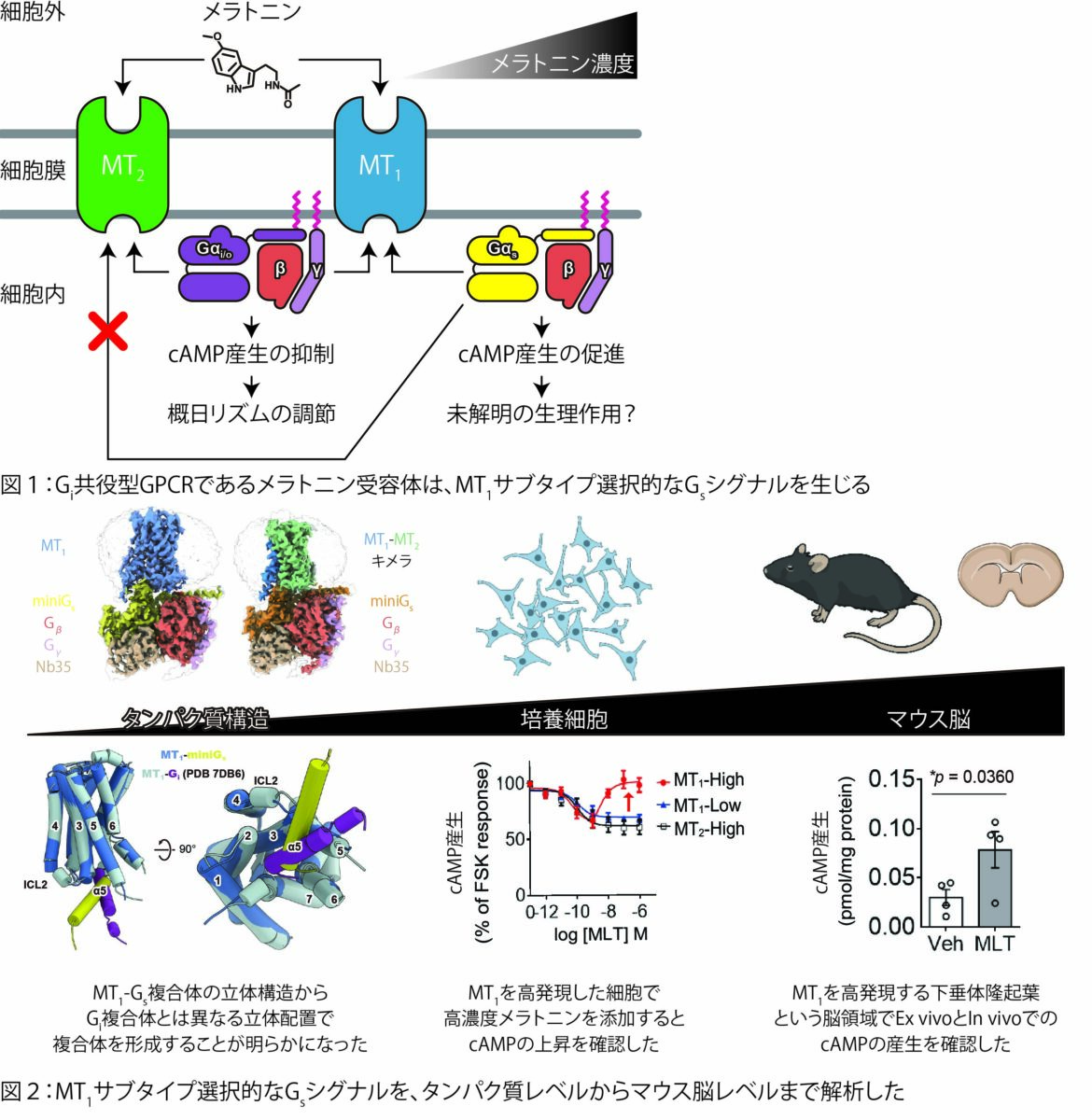
G protein-coupled receptors (GPCRs) transduce extracellular stimuli into intracellular signals by coupling to various heterotrimeric G proteins. However, the rules governing G protein preference remain largely elusive. MT1 and MT2 are prototypical Gi/o-coupled GPCRs responding to melatonin, a hormone secreted in a circadian manner. We show here that MT1, but not MT2, couples also to Gs proteins in vitro and activates the Gs/cAMP pathway upon long-term melatonin exposure in vivo, mimicking physiological dawn conditions. We solve the cryo–electron microscopy structure of the melatonin-MT1-Gs complex at 3.0 Å resolution, which reveals a distinct binding mode compared to the MT1–Gi complex. The third intracellular loop of MT1 emerges as a key stabilizer for Gs coupling. This structure of a GPCR primarily coupling to Gi, here in complex with Gs, provides structural and functional insights into G protein selectivity and circadian switch of G protein coupling.