2026-06-25 ミシガン大学
<関連情報>
- https://news.umich.edu/faded-letters-early-warnings-a-new-clue-for-aging-eyes/
- https://jamanetwork.com/journals/jamaophthalmology/article-abstract/2849772
高齢の米国成人におけるコントラスト感度低下の臨床的に意義のある閾値 A Clinically Relevant Threshold of Impaired Contrast Sensitivity Among Older US Adults
Shu Xu, PhD2; Mickey Nguyen, BS; Yunshu Zhou, MS;et al
OJAMA Ophthalmology Published:May 28, 2026
DOI:10.1001/jamaophthalmol.2026.1570
Key Points
Question At what level of contrast sensitivity (CS) do older adults begin to experience functional visual disability?
Findings This cohort study used nationally representative data from 4475 older adults in the US and identified a threshold of 1.60 logCS as the point at which CS was associated with self-reported visual disability. Each 0.1-unit decrease in baseline CS was associated with 12% higher odds of developing incident visual disability.
Meaning Although sensitivity and specificity were moderate, reflecting trade-offs at a single cutoff, a CS threshold of 1.60 logCS provides a benchmark for early functional vision loss in older adults.
Abstract
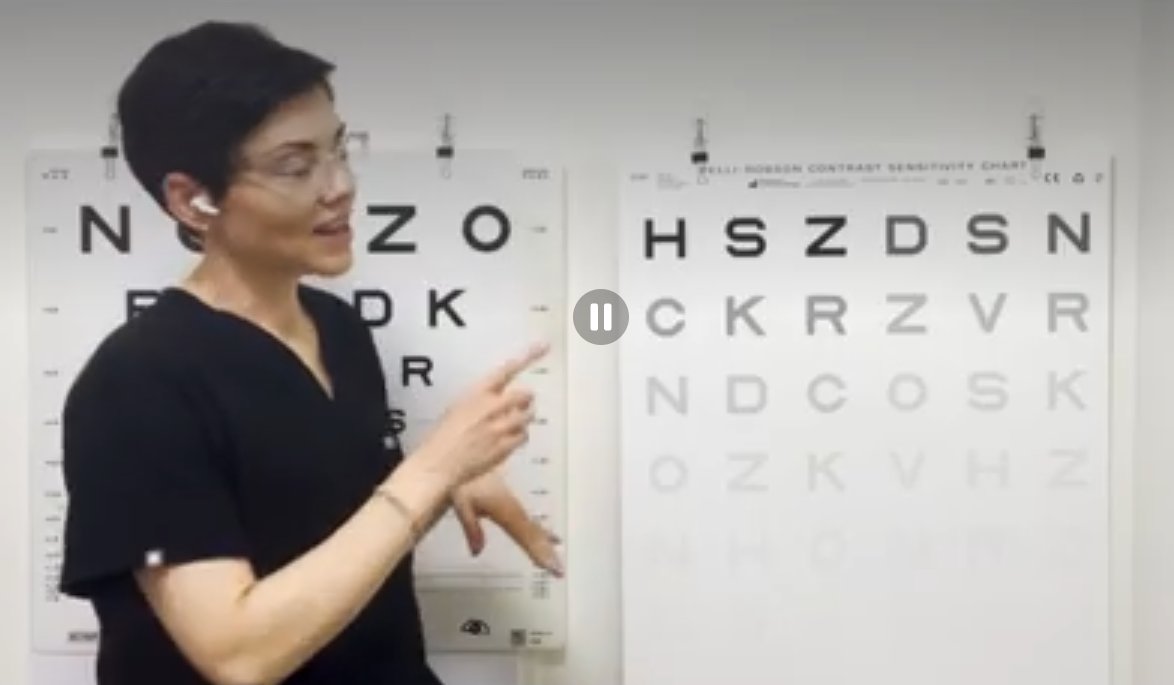
Importance Contrast sensitivity (CS) is a critical yet underused measure of visual function that reflects the ability to detect subtle differences in luminance between an object and its background. Although poor CS is associated with falls, cognitive decline, and reduced independence in older adults, existing thresholds lack functional relevance.
Objective To identify a CS threshold associated with functional visual disability.
Design, Setting, and Participants This longitudinal cohort study used data from rounds 12 (2022) and 13 (2023) of the National Health and Aging Trends Study (NHATS), a nationally representative cohort study of Medicare beneficiaries aged 65 years and older in the US. Analyses included 4475 community-dwelling participants with available binocular contrast sensitivity and self-reported vision data. Data were analyzed from September 2024 to January 2026.
Exposures Logarithm-scaled, binocular-presenting CS (logCS).
Main Outcomes and Measures Self-reported visual disability (SRVD), defined by difficulty recognizing faces, reading newspaper print, or seeing the television across a room. Covariates include age, education, race, income, visual acuity, frailty, and multimorbidity. Multiple logistic regression models were used to examine the association between CS and SRVD, and survey-weighted receiver operating characteristic (ROC) curve analyses were performed to identify an optimal CS threshold using the Youden index.
Results Weighted mean logCS (SE) among participants was 1.72 (<0.01). At baseline, the mean contrast sensitivity in individuals with SRVD was 1.49 (0.03) logCS compared with 1.73 (<0.01) logCS among those without SRVD. Participants who developed new SRVD at 1-year follow-up demonstrated a mean decline in logCS from 1.62 to 1.56 logCS. Each 0.1-unit decrease in baseline logCS was independently associated with 12% higher odds of incident SRVD (odds ratio, 1.12; 95% CI, 1.08-1.16). A threshold of 1.60 logCS maximized discrimination for functional visual disability (sensitivity, 67% [95% CI, 62%-71%]; specificity, 70% [95% CI, 69%-72%]).
Conclusions and Relevance In this cohort study, a threshold of 1.60 logCS represented the functional threshold at which older adults began to experience SRVD. This functionally anchored cutoff provides a benchmark for interpreting CS measures, although sensitivity and specificity were moderate.