
2026-07-14 マサチューセッツ工科大学(MIT)
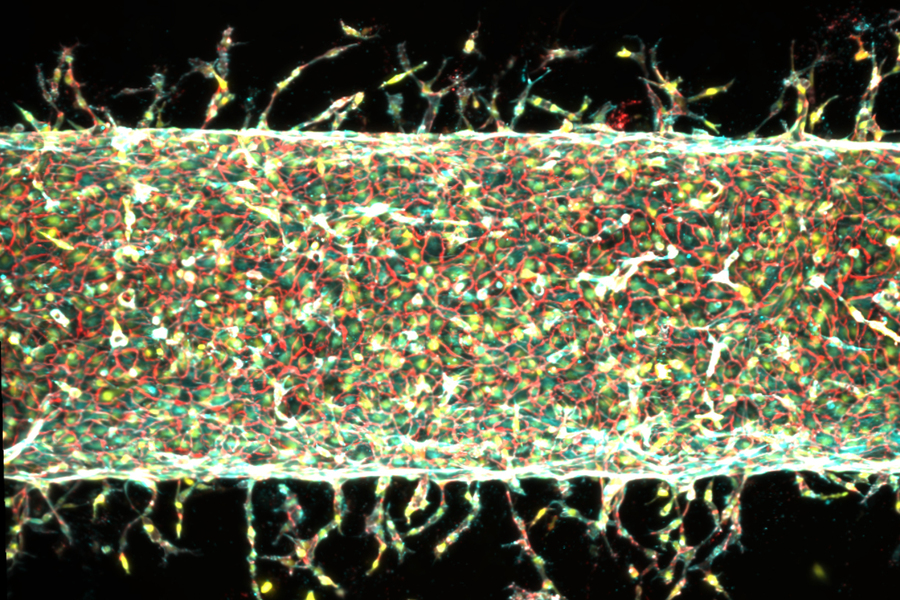
With mechanical stretching, MIT engineers can control how artificial arteries sprout new capillaries. Credit: Courtesy of the researchers
<関連情報>
- https://news.mit.edu/2026/mit-engineers-find-precise-way-to-grow-artificial-blood-vessels-0714
- https://www.pnas.org/doi/10.1073/pnas.2532667123
4D力パターン形成により血管新生の空間制御が可能になる 4D force patterning enables spatial control of angiogenesis
Sina Kheiri, Jessica Shah, Peiyuan Chai, +3 , and Ritu Raman
Proceedings of the National Academy of Sciences Published:July 6, 2026
DOI:https://doi.org/10.1073/pnas.2532667123
Abstract
Engineering organized microvascular networks remains a critical challenge in tissue engineering and regenerative medicine. While biochemical approaches for patterning angiogenesis via growth factor delivery have shown promise, their inability to pattern sustained growth factors with spatiotemporal control limits effectiveness. Here, we demonstrate that dynamically patterned mechanical forces enable precise spatiotemporal control over angiogenic sprouting. We developed a magnetically actuated human vessel-on-a-chip platform that integrates a perfusable endothelialized microchannel within a collagen matrix and allows noninvasive and tunable mechanical stimulation across three spatial dimensions and time (4D). Using an automated 3-axis actuator, we systematically investigated how strain magnitude, frequency, and direction modulate endothelial cell behavior and vessel morphogenesis. Dynamic mechanical stimulation at physiological strain magnitudes (5 to 15%) enhanced endothelial alignment and barrier function while promoting angiogenesis in a strain magnitude–dependent manner: lower dynamic strain (5%) maximized sprout initiation, whereas higher dynamic strain (15%) promoted elongation of sprouts. Sequential reorientation of strain direction reprogrammed sprouting trajectories along X, Y, and Z directions, generating complex sprout geometries such as L-shaped branches. RNA sequencing revealed mechanically induced transcriptional profiles distinct from unstimulated controls, characterized by upregulation of genes associated with angiogenesis, mechanotransduction, and extracellular matrix remodeling. Functional perturbation of PIEZO1 reduced strain-induced sprouting without altering barrier function, indicating that dynamic mechanical stimulation engages multiple mechanotransduction pathways to regulate angiogenesis. Collectively, these findings establish a strategy for spatiotemporally controlled angiogenesis through 4D force patterning to program vascular morphogenesis while preserving function. This approach provides a foundation for engineering hierarchically organized vascular networks for tissue regeneration.
00038-X/asset/2a1343e0-5097-49bb-bc25-9a184117b0d6/main.assets/gr1_lrg.jpg "検査法が自己免疫疾患の精密医療につながる可能性を示す(Test points to precision treatment for autoimmune condition)")