2026-07-17 大阪大学
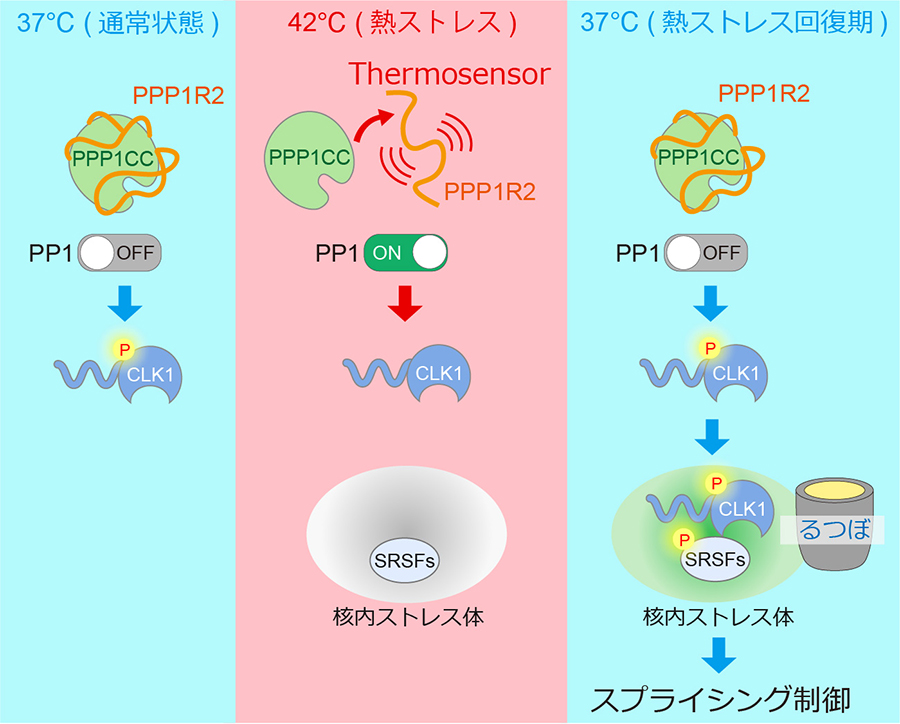
図1. 天然変性タンパク質PPP1R2は温度センサーとして働き、CLK1のリン酸化と核内ストレス体 (nSB) への局在化を制御します。その結果、nSBによるスプライシング制御が温度依存的に調節されます。
<関連情報>
- https://www.fbs.osaka-u.ac.jp/ja/research_results/papers/detail/1119
- https://www.sciencedirect.com/science/article/pii/S1097276526004235
核ストレス体によるスプライシング制御の温度感知機構 Thermo-sensing mechanisms of splicing control by nuclear stress bodies
Tsuyoshi Ueno, Shungo Adachi, Ichiro Taniguchi, Nobuo N. Noda, Kensuke Ninomiya, Tetsuro Hirose
Molecular Cell Available online: 16 July 2026
DOI:https://doi.org/10.1016/j.molcel.2026.06.034
Highlights
- CLK1 Ser341 phosphorylation controls its localization to nuclear stress bodies
- PP1 and RIOK2 reciprocally regulate CLK1 Ser341 phosphorylation
- PPP1R2 acts as a reversible thermosensor to regulate PP1 activity
- Temperature shifts the PP1-RIOK2 balance to control CLK1 Ser341 phosphorylation
Summary
Nuclear stress bodies (nSBs) are stress-inducible membraneless organelles formed on HSATIII long noncoding RNAs (lncRNAs) that regulate pre-mRNA splicing during thermal stress recovery. During stress, dephosphorylated serine/arginine-rich splicing factors (SRSFs) accumulate in nSBs, whereas upon stress removal, their kinase CLK1 is recruited to rephosphorylate SRSFs, thereby promoting target intron detention. However, the mechanism underlying CLK1 localization to nSBs has remained unclear. Using HeLa cells and cell-free reconstitution, we identify CLK1 Ser341 phosphorylation as a critical determinant of its nSB localization and define its regulatory mechanism. Ser341 is phosphorylated under normal conditions, dephosphorylated by protein phosphatase 1(PP1) during stress, and rephosphorylated by RIOK2 during recovery, thus enabling CLK1 localization to nSBs specifically during recovery. We further identify PPP1R2, an entirely intrinsically disordered PP1 inhibitory subunit, as a reversible thermosensor that dissociates under stress to activate PP1. Together, our findings reveal multilayered thermosensing mechanisms that coordinate the staged localization of SRSFs and CLK1 to nSBs, thereby regulating temperature-dependent pre-mRNA splicing.