2026-07-22 ジョンズ・ホプキンス大学(JHU)
<関連情報>
- https://hub.jhu.edu/2026/07/22/new-tool-detects-hidden-bias-in-medical-ai/
- https://www.nature.com/articles/s41746-026-02807-y
汎用的かつモダリティに依存しない監査アプローチを用いた医療AIにおけるデータセットバイアスの検出 Detecting dataset bias in medical AI using a generalized and modality agnostic auditing approach
Nathan Drenkow,Mitchell Pavlak,Keith Harrigian,Ayah Zirikly,Adarsh Subbaswamy,Mohammad Mehdi Farhangi,Nicholas Petrick & Mathias Unberath
npj Digital Medicine Published:29 May 2026
DOI:https://doi.org/10.1038/s41746-026-02807-y Unedited version
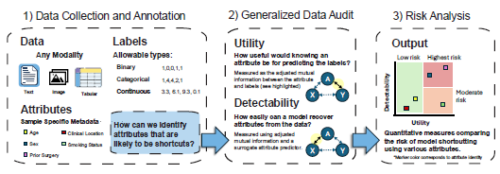
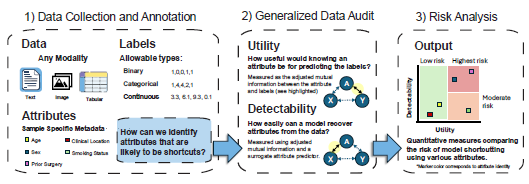
Fig. 1: Overview of Generalized Attribute Utility and Detectability-Induced bias Testing
(G-AUDIT).
Abstract
Despite many success stories along the path of Artificial Intelligence’s (AI) rise in healthcare, there are comparably many reports of significant shortcomings and unexpected behavior of AI in deployment. A major risk is AI’s reliance on association-based learning, where non-representative machine learning datasets can amplify latent bias during training and hide it during testing. To unlock new tools capable of detecting such AI bias issues, we present Generalized Attribute Utility and Detectability-Induced bias Testing (G-AUDIT). G-AUDIT is a data modality-agnostic dataset auditing approach that automatically quantifies shortcut learning risks by examining the interplay between task-level annotations, sensor-level measurements, and patient, environmental, and acquisition characteristics. We demonstrate the broad applicability of this method by analyzing a range of medical datasets across three distinct modalities (images, text, and tabular data) and machine learning tasks, successfully identifying potential shortcuts commonly overlooked by traditional qualitative methods.