2026-07-17 清華大学
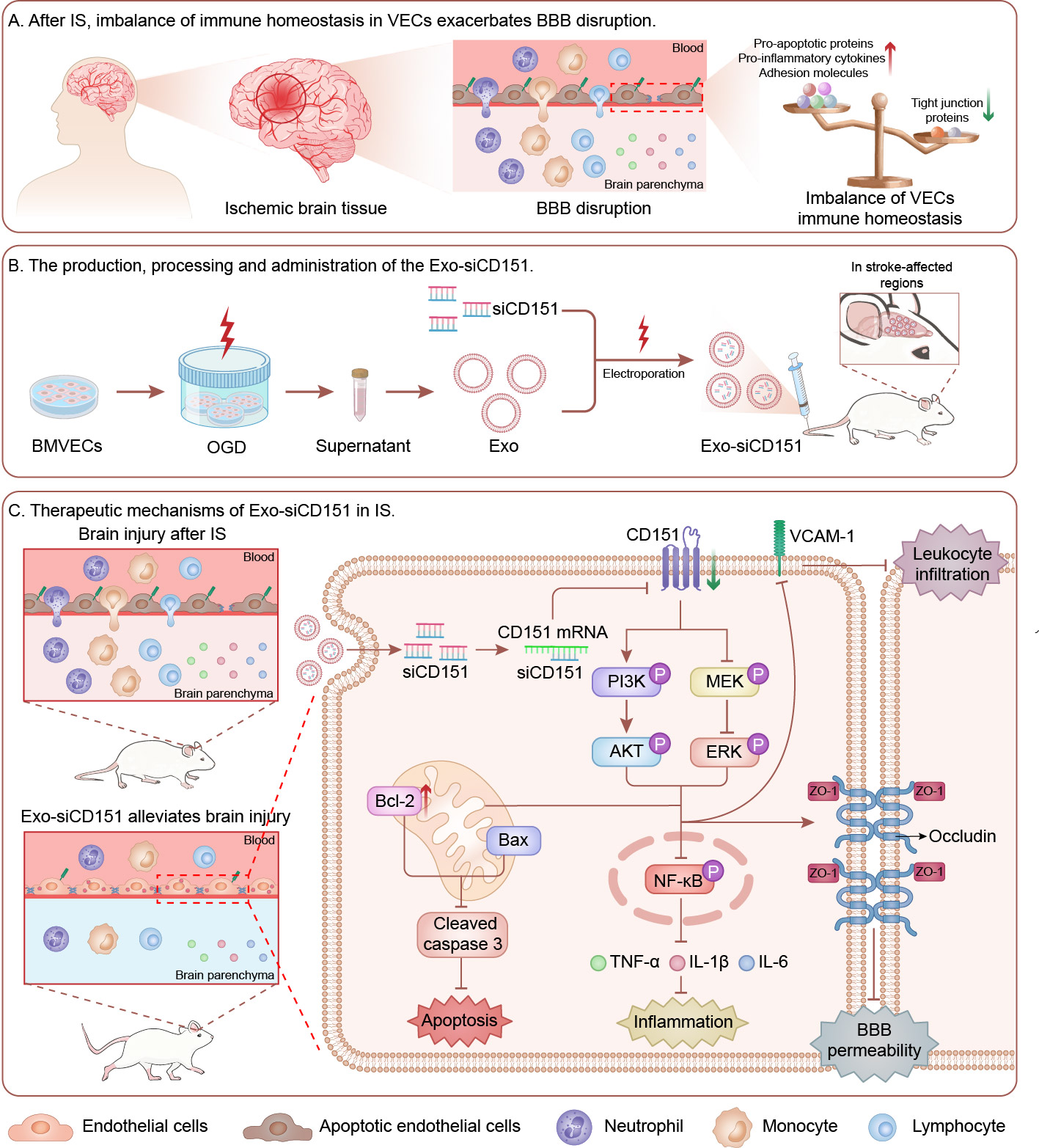
Figure 1. Exo-siCD151 alleviates blood-brain barrier disruption after ischemic stroke by maintaining immune homeostasis in brain endothelial cells
<関連情報>
- https://www.tsinghua.edu.cn/en/info/1245/15001.htm
- https://link.springer.com/article/10.1186/s12951-026-04467-2
- https://link.springer.com/article/10.1186/s12974-021-02171-6
標的エクソソーム送達型CD151 siRNAは脳内皮細胞の免疫恒常性を維持し、虚血性脳卒中後の血液脳関門破壊を軽減する Targeted exosome-delivered CD151 siRNA maintains brain endothelial cell immune homeostasis to alleviate blood–brain barrier disruption after ischemic stroke
Lu Xu,Yating Zhao,Yifan Liang,Couronne Adoummadji Benaindo,Xiaohui Sun,Xin-yue Wang,Ceshu Gao &Jian Wu
Journal of Nanobiotechnology Published: 25 April 2026
DOI:https://doi.org/10.1186/s12951-026-04467-2
Abstract
Background
Imbalance of immune homeostasis in vascular endothelial cells (VECs) plays a crucial role in blood–brain barrier (BBB) disruption and secondary brain injury following ischemic stroke (IS). Downregulation of CD151 in VECs has demonstrated significant therapeutic effects in IS. However, the role of CD151 in endothelial immune homeostasis remains unclear, and no noninvasive delivery system currently targets CD151 within the ischemic region. Therefore, we aimed to establish an exosome (Exo)-based delivery system capable of targeting and suppressing CD151 in ischemia-injured VECs and to explore the effects and molecular mechanisms of CD151 in regulating VEC immune homeostasis and BBB repair after IS.
Methods
Exosomes were isolated from oxygen–glucose deprivation (OGD)-preconditioned primary brain microvascular endothelial cells (BMVECs). The Exo-siCD151 system was established by loading siCD151 via electroporation. In vitro, Exo-siCD151 was applied to BMVECs to evaluate cellular targeting and its role in regulating endothelial immune homeostasis. In vivo, Exo-siCD151 was administered via tail vein injection in a rat model of transient middle cerebral artery occlusion (tMCAO) to assess targeting efficiency and therapeutic effects. RNA sequencing (RNA-seq) and western blotting were performed to identify signaling pathways involved in the protective effects of Exo-siCD151.
Results
RNA-seq identified CD151 as a key regulator of immune homeostasis in VECs. Following systemic administration, Exo-siCD151 selectively accumulated in ischemic brain regions, demonstrated specific targeting to VECs, and effectively downregulated CD151 expression. In tMCAO rats, Exo-siCD151 significantly reduced infarct volume, Evans blue extravasation, and brain edema, while improving neurological function. Both in vitro and in vivo, Exo-siCD151 partially restored immune homeostasis in VECs, as evidenced by reduced endothelial apoptosis, decreased inflammatory cytokine release and adhesion molecule expression, and increased tight junction protein levels. Mechanistically, inhibition of the MAPK/ERK signaling pathway and activation of the PI3K/AKT signaling pathway were involved in the neuroprotective effects of Exo-siCD151.
Conclusions
As a targeted delivery platform, Exo-siCD151 downregulated CD151 expression, modulated the MAPK/ERK and PI3K/AKT signaling pathways, and restored immune homeostasis in ischemia-injured VECs, thereby alleviating BBB disruption after IS. These findings suggest that Exo-siCD151 represents a promising therapeutic strategy targeting endothelial immune homeostasis for stroke recovery.
CD151の発現抑制はVCAM-1を介した白血球浸潤を制限し、実験的脳卒中後の神経生物学的損傷を軽減する Downregulation of CD151 restricts VCAM-1 mediated leukocyte infiltration to reduce neurobiological injuries after experimental stroke
Ceshu Gao,Wangyue Jia,Wendeng Xu,Qiong Wu & Jian Wu
Journal of neuroinflammation Published:22 May 2021
DOI:https://doi.org/10.1186/s12974-021-02171-6
Abstract
Background
Translational failures in anti-adhesion molecule therapies after stroke reveal the necessity of developing new strategies that not only interrupt leukocyte recruitment but also consider the inhibition of endothelial cell inflammation, verification of therapeutic time window, and normal function maintenance of circulating leukocytes. Our study focused on the potential therapeutic value of CD151 downregulation in improving current anti-adhesion molecule therapies.
Methods
Lentivirus intracerebroventricular administration was conducted to inhibit the CD151 expression and observe its functional influence on neurological injuries and outcomes. Then, immunohistochemistry and myeloperoxidase activity assessment were performed to explore the effects of CD151 expression on neutrophil and monocyte recruitment after rat cerebral ischemia. Primary rat brain microvascular endothelial cells were subjected to oxygen glucose deprivation and reoxygenation to elucidate the underlying working mechanisms between CD151 and VCAM-1.
Results
The CD151 downregulation remarkably reduced neurological injuries and improved neurological outcomes, which were accompanied with reduced neutrophil and monocyte infiltration after the CD151 downregulation. The VCAM-1 expression was remarkably decreased among the adhesion molecules on the endothelial cell responsible for neutrophil and monocyte infiltration. The activation of p38 MAPK and NF-κB pathways was restricted after the CD151 downregulation. p38 MAPK and NF-κB inhibitors decreased the VCAM-1 expression, and p38 acted as an upstream regulator of NF-κB. However, CD151 downregulation did not directly influence the neutrophil and monocyte activation.
Conclusions
Overall, CD151 regulated the expression of adhesion molecules. It also played a critical role in suppressing VCAM-1-mediated neutrophil and monocyte infiltration via the p38/NF-κB pathway. This study possibly provided a new basis for improving current anti-adhesion molecule therapies.