2026-08-12 リンショーピング大学
<関連情報>
- https://liu.se/en/news-item/felreglerade-immunceller-orsakar-tyst-inflammation-efter-hjartinfarkt
- https://www.ahajournals.org/doi/10.1161/ATVBAHA.126.324652
慢性冠症候群患者における好中球の自発的アポトーシスの遅延および制御性T細胞誘導性アポトーシスに対する抵抗性―短報 Neutrophils Exhibit Delayed Spontaneous Apoptosis and Resistance to Regulatory T-Cell–Induced Apoptosis in Patients With Chronic Coronary Syndrome—Brief Report
Maike Schneider, Camilla Skoglund, Rosanna W.S. Chung, and Lena Jonasson
Arteriosclerosis, Thrombosis, and Vascular Biology Published: 25 June 2026
DOI:https://doi.org/10.1161/ATVBAHA.126.324652
Abstract
BACKGROUND:
Persistent inflammation is linked to poor outcomes in patients with a history of myocardial infarction. The inflammatory state has been associated with activation of neutrophils as well as with regulatory T-cell (Treg) deficiency. The role of Tregs in the regulation of neutrophil survival has been postulated recently. Here, we investigated neutrophil apoptosis along with the potential impact of Tregs on neutrophil apoptosis in patients with postmyocardial infarction chronic coronary syndrome, compared with healthy controls.
METHODS:
Twenty patients and 19 controls were included. Neutrophil apoptosis was assessed after 5-hour culture with or without IL (interleukin)-10, TNF (tumor necrosis factor), or lipopolysaccharide. Neutrophil phenotype was evaluated through flow cytometry analysis of surface receptors (CD66b [cluster of differentiation] and CXCR4 [C-X-C chemokine receptor type 4]) and ex vivo release of cytokines and proteins. The ability of Tregs to induce neutrophil apoptosis was examined in autologous neutrophil-Treg cocultures.
RESULTS:
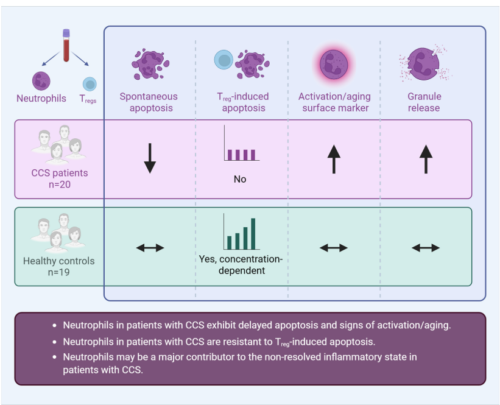
Spontaneous neutrophil apoptosis was significantly delayed in patients compared with controls (10.3% versus 19.2%, P=0.025). Also, neutrophils from patients overexpressed CD66b and CXCR4 and were more prone to release proinflammatory mediators. Notably, Tregs induced neutrophil apoptosis in healthy subjects, but not in patients, indicating a loss of Treg-mediated regulation in the latter. There was no evidence that IL-10 had any influence on neutrophil apoptosis. However, cell-to-cell contact was found essential for Treg-induced neutrophil apoptosis.
CONCLUSIONS:
Patients with postmyocardial infarction chronic coronary syndrome display delayed neutrophil apoptosis and a proinflammatory neutrophil phenotype that is resistant to Treg-mediated apoptosis. Neutrophil dysfunction may contribute to persistent inflammation in patients with postmyocardial infarction chronic coronary syndrome, and as such constitutes a novel therapeutic target.