2026-08-17 ブラウン大学
<関連情報>
- https://www.brown.edu/news/2026-08-17/malaria-drug-resistance
- https://www.nature.com/articles/s41591-026-04590-5
ウガンダにおける抗マラリア薬感受性低下に関連する熱帯熱マラリア原虫PX1多型の出現と蔓延 Emergence and spread of Plasmodium falciparum PX1 polymorphisms associated with decreased susceptibility to antimalarials in Uganda
Karamoko Niaré,Bersabeh Tafesse,Mayland Treat,Jacob M. Sadler,Martin Okitwi,Stephen Orena,Victor Asua,Oriana Kreutzfeld,Jenny Legac,Jacob Marglous,Samuel L. Nsobya,Adoke Yeka,Dave Richard,Michael T. Ferdig,Angana Mukherjee,Philip J. Rosenthal,Jonathan J. Juliano,Jeffrey A. Bailey & Melissa D. Conrad
Nature Medicine Published:17 August 2026
DOI:https://doi.org/10.1038/s41591-026-04590-5
Abstract
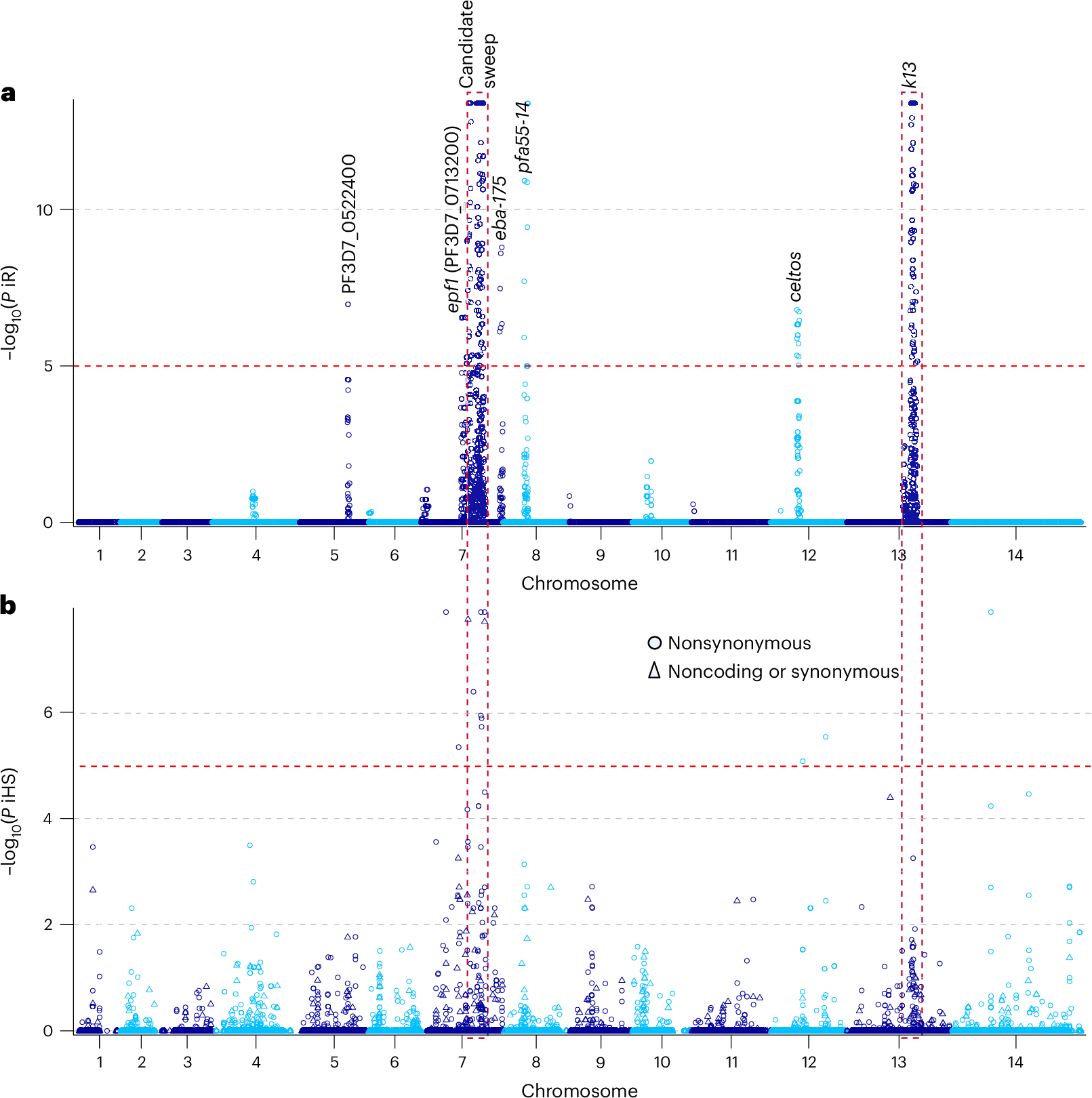
Artemisinin-based combination therapies are the cornerstone of malaria treatment and control. In Africa, artemether–lumefantrine is the most widely used first-line artemisinin-based combination therapy, but its efficacy in Uganda is increasingly threatened by the emergence of artemisinin partial resistance and reduced lumefantrine susceptibility. To identify loci contributing to this decreased susceptibility, here we assessed signatures of selection in 157 whole-genome sequences of Plasmodium falciparum from Uganda. Although extended haplotypes were observed around Kelch13 C469Y and A675V mutations, the strongest signal of recent selection was centered on a segment of chr. 7 encoding the phosphoinositide-binding protein (PX1, PF3D7_0720700). A haplotype, represented by three PX1 mutations (L1222P, M1701I and D1705N) and two deletions (designated PIN), was first seen in 2008 and rapidly increased, reaching a prevalence >50% in northern Uganda by 2016 and eastern Uganda by 2023. PIN-carrying parasites showed significantly decreased ex vivo susceptibilities to lumefantrine, mefloquine and dihydroartemisinin, an active metabolite of artemether. A parasite strain in which px1 was disrupted in vitro showed increased susceptibility to the three drugs. Thus, PX1 polymorphisms appear to impact on the susceptibilities of African malaria parasites to key drugs.