2026-08-20 東北大学
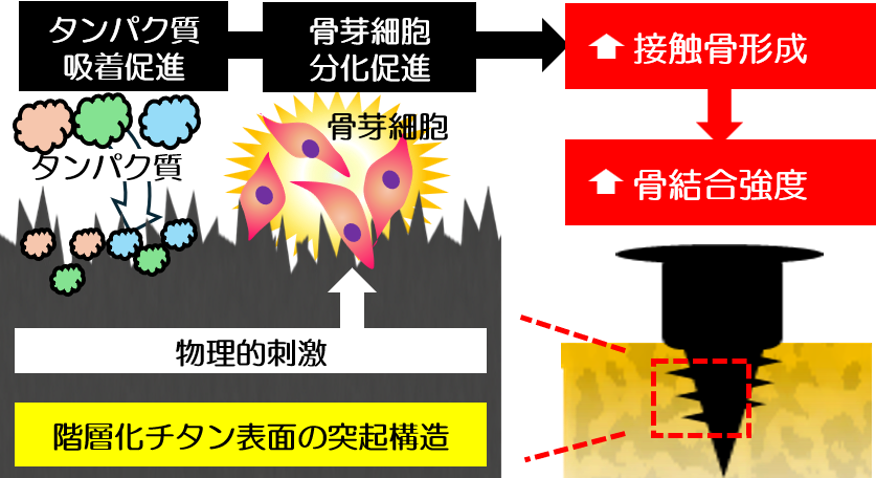
図1. 階層化チタン表面による物理的作用を介した骨結合促進メカニズムの概念図
<関連情報>
- https://www.tohoku.ac.jp/japanese/2026/08/press20260820-02-nanospike.html
- https://link.springer.com/article/10.1186/s11671-026-04824-y
マイクロスケールおよびナノスケールの階層構造チタン表面上の異方性ナノスパイクは、歯科インプラントの早期骨結合を促進する Anisotropic nanospikes on micro and nanoscale hierarchical titanium surfaces enhance early osseointegration of dental implants
Takayuki Ohtake,Haruki Shikanai,Masahiro Yamada,Jun Watanabe & Hiroshi Egusa
Discover Nano Published:13 August 2026
DOI:https://doi.org/10.1186/s11671-026-04824-y
Abstract
Anisotropic titanium nano-surfaces produced by alkali etching exert diverse biological effects through physicochemical cues derived from anisotropically distributed nanospikes. These effects can be further enhanced by hierarchically superimposing nanostructures onto micro-roughened surfaces. This study aimed to investigate the effects of micro/nano three-dimensionally hierarchical titanium surfaces on the osteoblastic functions and osseointegration of dental implants. Three-dimensionally nano-roughened titanium surfaces fabricated using a combination of hot acid and alkaline treatments showed a higher density and anisotropic distribution of nanospikes than that on conventional nano-roughened surfaces, while exhibiting key physicochemical features similar to those of conventional nano-roughened surfaces, including superhydrophilicity and negative surface potential associated with surface hydroxyl groups. These three-dimensionally nano-roughened surfaces significantly enhanced bovine serum albumin adsorption. They also promoted the proliferation and osteoblastic differentiation of mouse bone marrow stromal cells compared with conventional micro-roughened or nano-roughened titanium surfaces. In vivo, titanium implants with three-dimensional nano-surfaces showed significantly greater osseointegration strength than that of micro-roughened implants when placed in the rat maxillary molar region. This enhancement was associated with enhanced early bone formation and increased contact and distant osteogenesis. Exploratory association analysis suggested that the composite topographical descriptor reflecting nanospike density and spatial heterogeneity was associated with increased albumin adsorption under controlled in vitro conditions. Collectively, micro/nano three-dimensionally hierarchical titanium surfaces are associated with enhanced early osseointegration and promoted osteoblastic differentiation, highlighting their potential for advanced implant surface design.