2026-08-24 バーミンガム大学
<関連情報>
- https://www.birmingham.ac.uk/news/2026/new-study-uncovers-tiktok-mental-health-advice-risks-for-young-people
- https://journals.sagepub.com/doi/10.1177/20552076261479043
- https://www.sciencedirect.com/science/article/pii/S0378216626000548
メディアリテラシー、プラットフォームのイメージ、そしてメンタルヘルスのインフルエンサー:若者はTikTok上のメンタルヘルスコンテンツにどのように反応するのか Media literacies, platform imaginaries and mental health influencers: How young people respond to mental health content on TikTok
Alex Christiansen, Ruth Page, […], and Emma Garavini
Digital Published:August 21, 2026 Published:August 21, 2026
DOI:https://doi.org/10.1177/20552076261479043
Abstract
Objective
Social media is increasingly used as a source of mental health information for young people, with influencers playing a key role in public health communication. However, little is known about how young people engage with influencer mental health content and the media literacy skills they use to evaluate it. The objective of this study is to explore and evaluate the self-reported media literacy skills and beliefs that young people use when they encounter mental health content on TikTok.
Methods
The study uses qualitative, thematic analysis to provide an empirical account of how young people interpret mental health content from influencers on TikTok. Research was conducted via eighteen group (n = 73 participants) and individual interviews (n = 13) with eighty-six participants in the United Kingdom. The analysis focused on self-reported media literacy skills and strategies for navigating influencer-led mental health content.
Results
The study identifies three contextual challenges in young people’s responses to mental health content on TikTok: (I) reliability and relatability act as distinct but complementary criteria used to assess influencers and their mental health content; (II) platform beliefs influence willingness to engage with mental health content; and (III) algorithmically driven platform design hinders critical thinking about mental health content.
Conclusions
These findings highlight the sophistication of young people’s media literacy skills alongside the significant, contextual barriers, which hinder the use of social media as a channel for mental health support from influencers. Our results suggest that public health campaigns may need to take a more platform-sensitive approach to online communication, acknowledging the ways platform-driven beliefs and design shape how and why young people engage with mental health content.
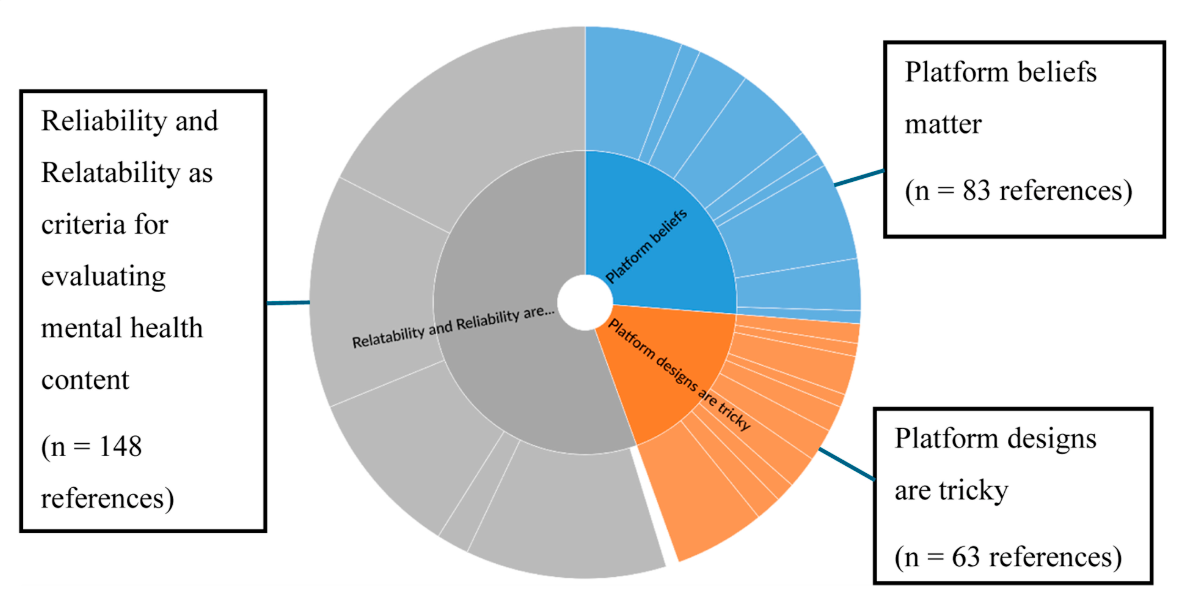
Figure 2. Sunburst chart produced in NVivo 14.23.2 showing the quantity of references for the three over-arching media literacy themes.
TikTokでのメンタルヘルスに関するアドバイス Mental health advice on TikTok
Alex Christiansen, Shioma-Lei Craythorne, Paul Crawford, Michael Larkin, Ruth Page
Journal of Pragmatics Available online: 17 March 2026
DOI:https://doi.org/10.1016/j.pragma.2026.03.002
Highlights
- First study of mental health advice by health professionals and wellness influencers on TikTok
- Analyses a dataset of 27,000 TikTok video voice-overs using corpus-pragmatic methods.
- Identifies advice via if-conditionals to analyse audience positioning.
- Adapts the Mental Health Quotient for linguistic analysis of prompts.
- Findings reveal contrasting healthcare models circulating in TikTok’s algorithmic feeds.
Abstract
In this paper, we provide the first, large-scale corpus-pragmatic analysis of mental health advice by social media influencers on TikTok. We identify advice-giving in large datasets focusing on if-conditionals as a specific form that allows us to analyse how the audience is positioned relative to a need and the solution which is then proposed. To identify the different ways in which mental health issues are presented, we use an adapted version of the ‘mental health quotient’ (Newson and Thiagarajan, 2020), as a linguistically informed framework for differentiating between lay discussions of mental health and those that invoke specific disorders. We sample a corpus of over 27,000 TikTok videos from 85 mental health influencers, using corpus-scale identification to extract and analyse if-conditionals produced by mental health professionals and wellness influencers. Our analysis of the protasis shows how these two types of influencers use prompts that share some similarities but also rely on fundamentally different models of healthcare. The relationship between these prompts and the information and recommendations in the apodosis show how health professionals rely on diagnostic information and therapeutic advice, while wellness influencers recommend embodied practice and products to treat mental health issues. These findings set out the distinctive ecosystem of healthcare which is emerging within the algorithmically driven contexts of sites like TikTok.
00228-7/asset/2185b608-70bd-460f-9efe-4cee78d3ddb8/main.assets/gr1.jpg "臨床試験、直腸がん治療で大規模手術を回避できることを示す(Clinical trial to treat rectal cancer spares major surgery)")