2026-08-27 東京科学大学
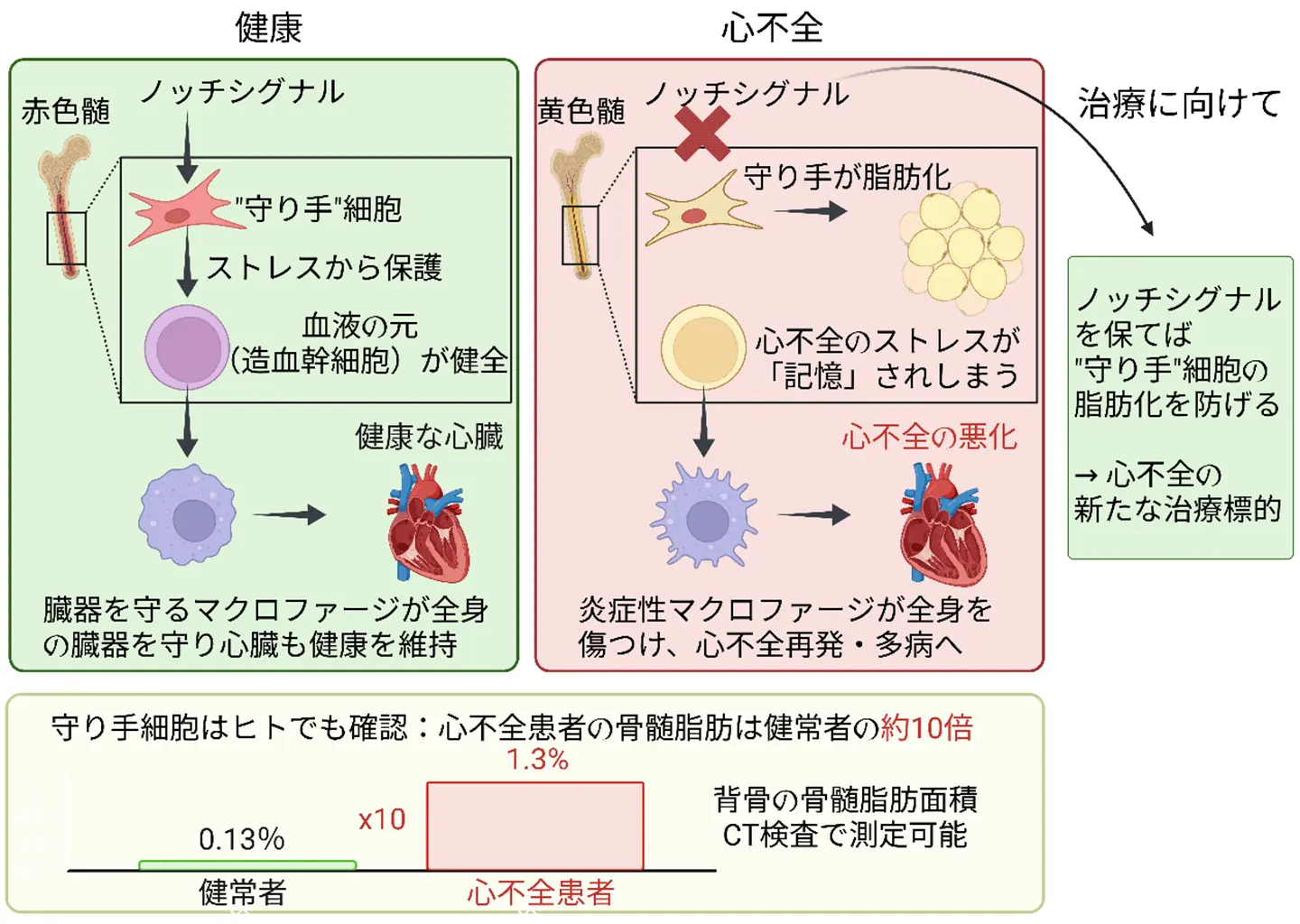
図1. 心不全で骨髄の“守り手”細胞が脂肪細胞へと変化する仕組みと新たな治療標的(模式図)。
<関連情報>
骨髄ニッチの変化が心臓機能障害を引き起こす中心的な先天性免疫記憶を形成する Altered bone marrow niche forms central innate immune memory driving cardiac dysfunction
Kohsaku Goto,Yukiteru Nakayama,Junichi Sugita,Tsukasa Oshima,Kunihito Kani,Atsushi Kobayashi,Naoto Setoguchi,Yuxiang Liu,Yiyi Yang,Jiaxin Ku,Ryoko Uchida,Eriko Hasumi,Takashi Nagasawa,Issei Komuro,Norihiko Takeda,Ichiro Manabe & Katsuhito Fujiu
Nature Communications Published:26 August 2026
DOI:https://doi.org/10.1038/s41467-026-76178-z
Abstract
We previously showed that heart failure induces innate immune memory in hematopoietic stem and progenitor cells, which contributes to recurrence of heart failure and impaired stress responses in multiple organs. While the bone marrow microenvironment maintains blood cell formation, its role in this memory remains poorly understood. Here we show that bone marrow mesenchymal stromal cells expressing the leptin receptor influence hematopoietic stem and progenitor cells to promote cardiac pathology. Transplanting these stromal cells from mice with heart failure together with healthy hematopoietic cells caused inflammatory macrophages to accumulate in the heart and worsened cardiac remodeling. Mechanistically, heart failure reduced a stromal subpopulation producing heparin-binding epidermal growth factor and suppressed growth factor signaling in hematopoietic cells. Heart failure also activated a fat-forming program in stromal cells. Notably, an equivalent stromal subpopulation exists in human bone marrow, and heart failure was associated with increased bone marrow fat in humans, identifying the bone marrow microenvironment as a regulator of innate immune memory.