2026-09-30 北海道大学,東北大学,理化学研究所
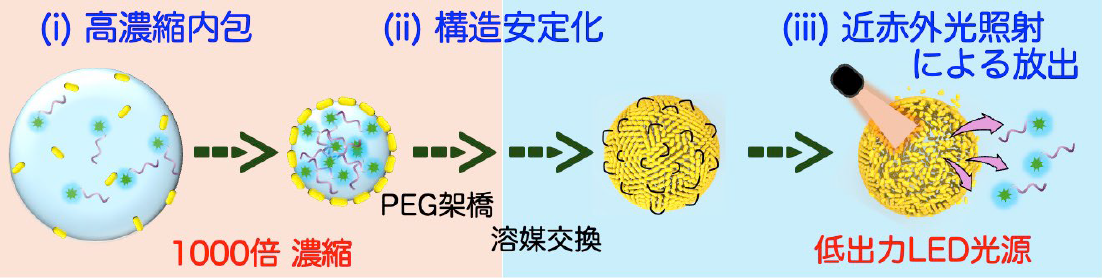
溶質濃縮によって生じる相分離を利用し、DNAなどの水溶性物質を1,000倍以上に濃縮して内包する金ナノロッドカプセルを作製した。PEG架橋によって水中でのカプセル構造を安定化するとともに、低出力近赤外LED光によってカプセルを崩壊させ、内包物を効率的に放出することに成功した。
<関連情報>
- https://www.hokudai.ac.jp/news/2026/09/post-2453.html
- https://onlinelibrary.wiley.com/doi/10.1002/smll.75754
効率的な内包と放出を可能にする近赤外光応答性金ナノロッドカプセル NIR-Responsive Gold Nanorod Capsules for Efficient Cargo Encapsulation and Release
Dongyu Zhang, Takehiro Yachi, Daisuke Unabara, Tasuku Hamaguchi, Koji Yonekura, Kiyoshi Kanie, Kuniharu Ijiro, Hideyuki Mitomo
Small Published: 23 September 2026
DOI:https://doi.org/10.1002/smll.75754
ABSTRACT
Gold nanoparticle-based vesicular nanostructures are attractive drug delivery platforms because of their tunable plasmonic properties; however, simultaneously achieving efficient cargo encapsulation, robust aqueous stability, and controllable near-infrared (NIR)-triggered release remains challenging. Herein, water-dispersible and NIR-responsive gold nanorod capsules (Au NrCs) are fabricated from mini-gold nanorods (mini-Au NRs) and small amphiphilic hexaethylene glycol (EG6) ligands via a solute-induced phase separation strategy. Owing to their compact dimensions and tunable longitudinal localized surface plasmon resonance, the mini-Au NRs enable assembly within sub-200 nm nanocapsules while retaining NIR responsiveness. During capsule formation, nanoparticles and DNA cargoes are simultaneously encapsulated and concentrated within the capsules through liquid-liquid phase separation, achieving approximately 90% DNA encapsulation efficiency and more than 1000-fold enrichment. Furthermore, amino-terminated EG6 ligands enable post-assembly crosslinking of the Au NrCs with diepoxy-polyethylene glycol, improving aqueous stability and dispersibility. The resulting Au NrCs exhibit efficient cargo release (>95% within a few minutes) under low-power 810 nm NIR LED irradiation through capsule disassembly, highlighting the potential of plasmonic nanocapsules for externally controlled delivery under relatively mild NIR LED irradiation conditions. These results establish a plasmonic nanocarrier platform integrating concentration-assisted cargo encapsulation, enhanced aqueous stability, and controllable NIR-triggered release, providing a basis for future drug delivery applications.