2026-09-30 東京科学大学
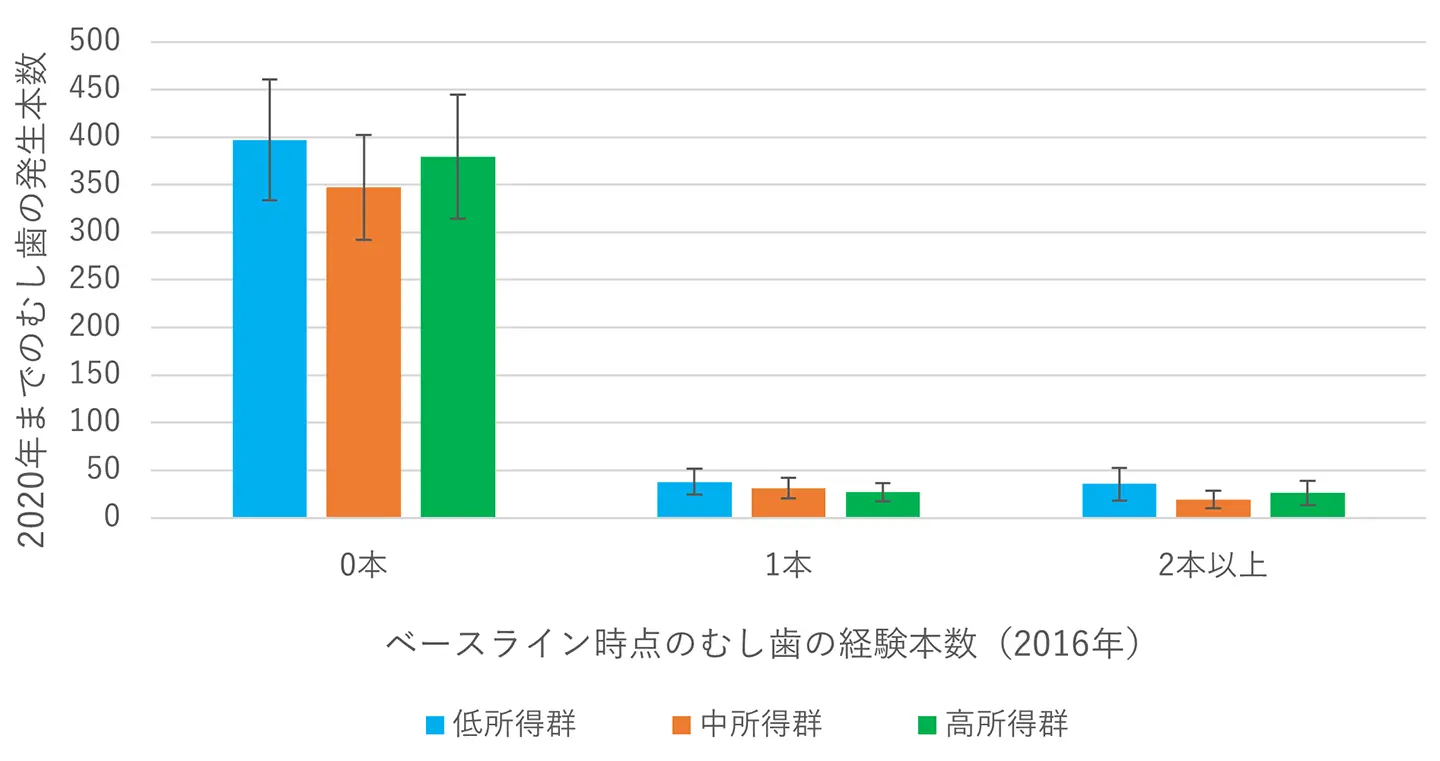
図. それぞれの所得群におけるむし歯の経験本数ごとのむし歯の発生本数
<関連情報>
- https://www.isct.ac.jp/ja/news/2ce3rpjrze5q
- https://www.sciencedirect.com/science/article/pii/S0300571226005300
日本の小学生におけるう蝕発生率およびう蝕リスクの評価:A-CHILD縦断研究の結果 Evaluation of caries incidence and caries risk among elementary school children in Japan: results from A-CHILD longitudinal study
Satomi Shimada, Jun Aida, Aya Isumi, Takeo Fujiwara
Journal of Dentistry Available online 27 June 2026
DOI:https://doi.org/10.1016/j.jdent.2026.106860
Abstract
Objectives
A population approach focuses on improving the health status of the entire population, depending on the fact that the majority of diseases occur among low-risk individuals rather than high-risk individuals. However, the onset of permanent tooth caries in children with high or low caries risk remains unclear, especially among children of different socioeconomic statuses. This study investigated the distribution of caries occurrence in children across different caries experience and income groups.
Methods
This cohort study was based on the Adachi Child Health Impact of Living Difficulty (A-CHILD) study, which surveyed all elementary school children in Adachi City, Japan. The explanatory variables were the number of permanent carious teeth and three tertiles of income when children were 7 or 8 years old in 2016. The outcome was an increase in permanent carious teeth when children were 11 or 12 years old, between 2016 and 2020. Negative binomial regression analyses were applied with adjustment for sex.
Results
Among the participants (n=3,321), the low-income group had 1.44 (95% CI: 1.14; 1.81) times higher risk than the high-income group. Children with two or more carious teeth showed 2.52 (95% CI: 1.57; 4.06) times higher caries risk than caries-free children. However, over 80% of carious teeth occurred among caries-free children in all income groups.
Conclusions
The majority of new caries cases occurred not merely in high-risk children but in a large number of initially low-risk children, regardless of income level. These findings suggest the importance of a population approach in preventing caries.
Clinical Significance
The majority of new caries lesions occurred in caries-free children across all income statuses. The population approach appears appropriate for preventing the incidence of dental caries among elementary school children.