2026-09-15 京都大学
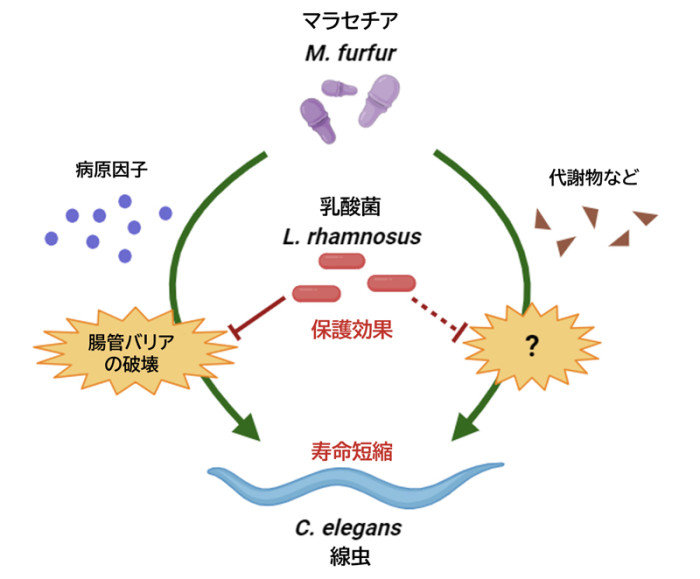
本研究の概略図(作成者:岸田千穂、谷本佳彦)
<関連情報>
- https://www.kyoto-u.ac.jp/ja/research-news/2026-09-15-1
- https://academic.oup.com/femsmicrobes/advance-article/doi/10.1093/femsmc/xtag049/8788353
代替宿主である線⾍(Caenorhabditis elegans)におけるマラセチア・フルフル(Malassezia furfur)の病原性および腸管バリア破壊能は、ラクティカセイバチルス・ラムノサス(Lacticaseibacillus rhamnosus)によって部分的に軽減される Pathogenicity and intestinal barrier disruptive ability of Malassezia furfur in an alternative model host Caenorhabditis elegans is partially alleviated by Lacticaseibacillus rhamnosus
Chiho Kishida,Kanamu Chikuba,Chinatsu Yamamura,Himari Kanatani,Ayano Tsuru,Satoka Takabayashi,Xueyang Wu,Misaki Okahata,Yoshihiko Tanimoto,Eriko Kage-Nakadai
FEMS Microbes Published:08 September 2026
DOI:https://doi.org/10.1093/femsmc/xtag049
Abstract
Malassezia furfur is fungi associated with various diseases; however, the mechanisms underlying its pathogenicity and the relationship between probiotics and fungi remain largely unknown. In the present study, Caenorhabditis elegans was used as the model host to evaluate M. furfur pathogenicity. Additionally, effects of lactic acid bacteria against M. furfur pathogenicity were evaluated. Compared to Escherichia coli OP50 (OP, control), both live and heat-killed M. furfur reduced the lifespan and body size of C. elegans, although heat-killed M. furfur was less effective than live M. furfur in lifespan shortening. Furthermore, unlike heat-killed M. furfur, live M. furfur disrupted the nematode intestinal barrier. Loss-of-function mutants of nsy-1 and sek-1, which encode components of the MAPK signaling pathway, were susceptible to M. furfur, suggesting their involvement in the defense against M. furfur infection. Expression of genes involved in host defense and of those coding for C-type lectin domain-containing proteins and antimicrobial peptides was upregulated in M. furfur-infected C. elegans. Lacticaseibacillus rhamnosus (LR) significantly ameliorated lifespan shortening and body size reduction in M. furfur-infected C. elegans and protected against intestinal barrier disruption, suggesting that LR protects nematodes from M. furfur virulence. This study highlights M. furfur pathogenicity and intestinal barrier disruptive ability in C. elegans and suggests that the M. furfur virulence is partially attenuated by LR.