2026-09-14 東北大学
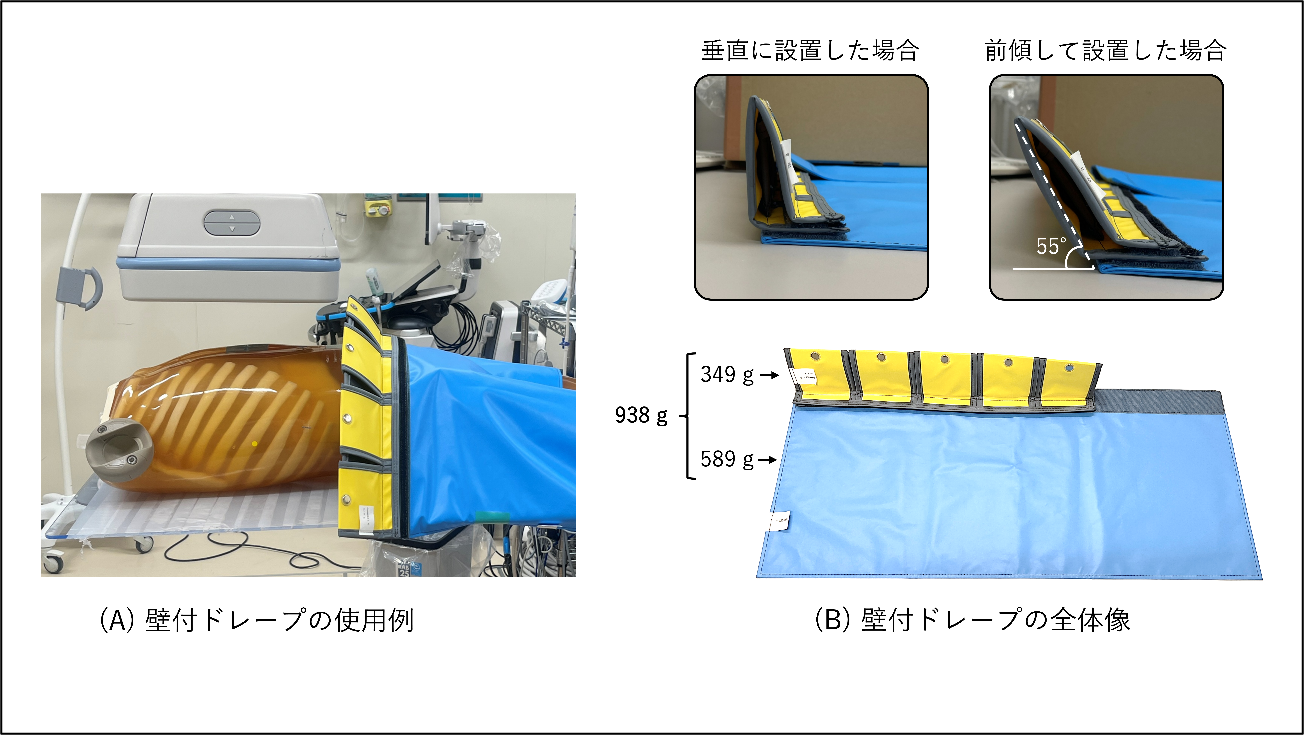
図1. 開発した「壁付ドレープ」と壁の設置例 壁は取り外し可能な形で取り付けられ、使用する側に合わせて左右を変更することができる。また壁を前傾させると線量低減効果が増す場合がある。
<関連情報>
- https://www.tohoku.ac.jp/japanese/2026/09/press20260914-02-drape.html
- https://www.sciencedirect.com/science/article/pii/S0969806X26008224
インターベンショナルラジオロジーにおける職業放射線防護を強化するための、取り外し可能な遮蔽壁を備えた軽量X線遮蔽ドレープ Lightweight X-ray shielding drape with a detachable shielding wall for enhanced occupational radiation protection in interventional radiology
Kodai Sagehashi, Eishin Sasaki, Minori Ishida, Hina Imai, Kazuma Kanke, Tomoya Sato, Mami Nemoto, Kanae Konta, Toshiki Kato, Masahiro Sota, Yoshihiro Haga, Yuji Kaga, Koichi Chida
Radiation Physics and Chemistry Available online: 25 August 2026
DOI:https://doi.org/10.1016/j.radphyschem.2026.114412
Highlights
- Developed a 938-g shielding drape with a detachable shielding wall.
- Shielding performance was evaluated under seven PCI projections.
- The shielding wall improved scatter radiation shielding performance.
- Eye lens and hand doses were reduced by approximately 70–80%.
- Effective shielding was achieved with only 0.125-mmPb lead equivalence.
Abstract
Occupational radiation exposure remains a concern during interventional radiology (IR) procedures. Patient-mounted shielding drapes can reduce exposure, but conventional drapes are heavy, and performance of lightweight drapes with shielding walls has not been investigated. This study developed a lightweight X-ray shielding drape with a detachable shielding wall and evaluated its radiation shielding performance under different projection angles and operator positions. A phantom study was performed using an angiography system under seven projection angles during percutaneous coronary intervention. Ambient dose equivalent was measured at four operator locations: the torso, eye lens, forward-leaning eye lens, and hand. The device consisted of a shielding drape and a detachable shielding wall, both with a lead equivalence of 0.125 mmPb and a combined weight of 938 g. Dose reduction was evaluated under four conditions: no protection, drape alone, drape with a vertical shielding wall, and drape with a forward-tilted shielding wall. The shielding wall provided protection compared with the drape alone. Dose reductions of 70–80% were achieved at the forward-leaning eye lens and hand positions. The effect varied with projection angle and was limited at the eye lens position for some LAO and CAU projections. No significant difference was observed between the vertical and forward-tilted configurations. These findings indicate that the lightweight shielding drape can provide radiation protection despite its low lead equivalence. Its detachable shielding wall may provide complementary protection at positions that are difficult to cover with conventional devices. The lightweight design may reduce the physical burden on patients during IR procedures.