2026-09-15 国立がん研究センター
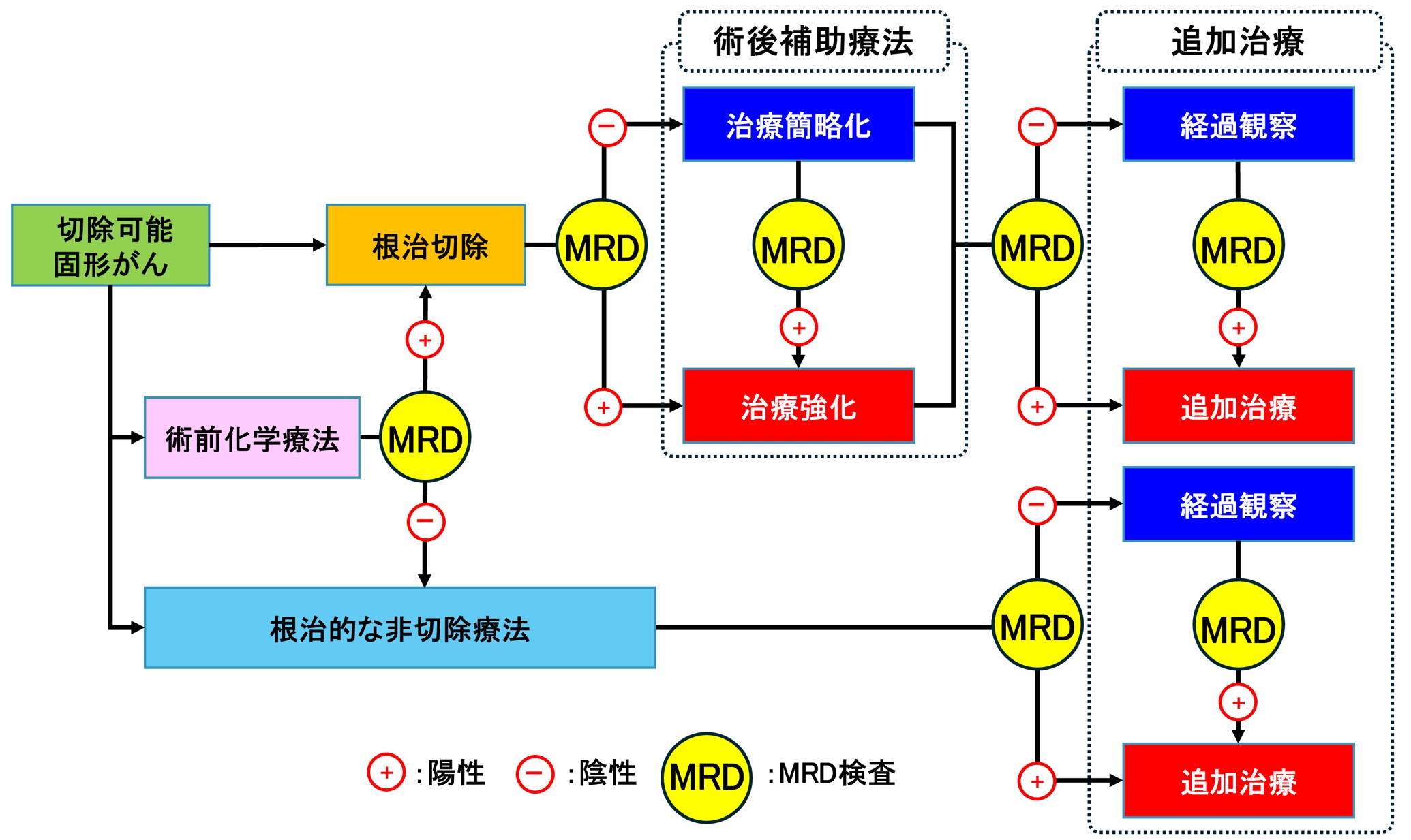
図1 MRD検査を用いた個別化治療開発のコンセプト
<関連情報>
- https://www.ncc.go.jp/jp/information/researchtopics/2026/0915/index.html
- https://www.cell.com/cancer-cell/abstract/S1535-6108(26)00357-0
分子レベルでの残存疾患:切除可能な固形腫瘍の治療における新たな道筋を切り拓く Molecular residual disease: Charting a new path for treating resectable solid tumors
Shin Kobayashi ∙ Tadayoshi Hashimoto ∙ Hideaki Bando ∙ … ∙ Qian Shi ∙ Eiji Oki ∙ Takayuki Yoshino
Cancer Cell Published:September 14, 2026
DOI:https://doi.org/10.1016/j.ccell.2026.08.001
Abstract
Molecular residual disease (MRD), detected via circulating tumor DNA (ctDNA) after curative-intent surgery, identifies resectable solid tumor patients at high recurrence risk, thereby enabling enriched trials with larger effect sizes and smaller samples. Yet enrichment narrows the eligible population and thus challenges conventional randomized designs. We propose an MRD Registry as an external control cohort that integrates quantitative ctDNA data with outcomes to validate ctDNA dynamics as response indicators—facilitating efficient MRD-based trial design and accelerating novel therapy development.