2026-10-19 国立成育医療研究センター
<関連情報>
- https://www.ncchd.go.jp/press/2026/1019.html
- https://www.sciencedirect.com/science/article/pii/S1323893026000961
乳児皮膚炎は、成人のアトピー性皮膚炎様の皮膚炎症の悪化に関連する、長期にわたる先天性免疫の刷り込みを引き起こす Infant dermatitis induces long-lasting innate immune imprinting associated with the exacerbated adult atopic dermatitis-like skin inflammation
Hiroki Sugiyama, Masato Tamari, Yuka Hayashi, Naoko Nagano, Ayako Yamada, Keisuke Orimo, Kyoko Saito, Ryo Matsuoka, Kenichiro Motomura, Satoshi Fujita, Hisataka Nakazaki, Hiromichi Yamamoto, Taro Higuchi, Ken Arae, Masashi Ikutani, Kiyoshi Yamaguchi, Yoichi Furukawa, Shuichi Ito, Katsuko Sudo, Hirohisa Saito,…,Hideaki Morita
Allergology International Available online: 3 October 2026
DOI:https://doi.org/10.1016/j.alit.2026.08.005
Abstract
Background
Atopic dermatitis (AD) frequently begins during infancy, and AD arising in early infancy represents a predictor of persistent AD. However, the mechanisms by which infantile skin inflammation programs future inflammatory susceptibility remain poorly understood.
Methods
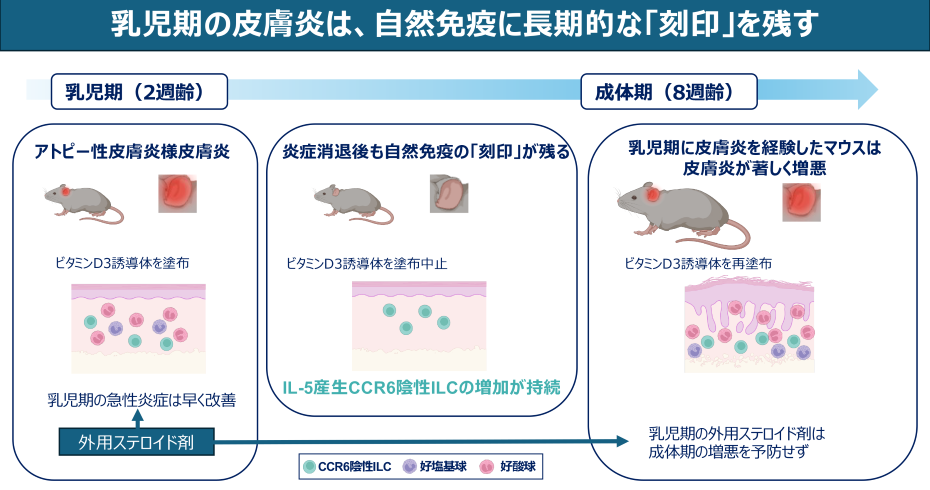
Two-week-old mice were treated with MC903 (vitamin D analogue) for 2 weeks and allowed to recover until adulthood. Topical corticosteroids were administered to a subset of mice after the induction of dermatitis during infancy. At 8 weeks of age, mice were rechallenged with MC903. Skin inflammation was evaluated by ear thickness, histological analysis, quantitative PCR, and flow cytometry. IL-4 and IL-5 reporter mice were used to identify the cellular sources of type 2 cytokines, and ILC populations were analyzed by uniform manifold approximation and projection.
Results
MC903 application during infancy induced AD-like dermatitis with epidermal hyperplasia, increased type 2 cytokines, and infiltration of eosinophils, basophils, and ILCs. Mice experiencing infantile dermatitis developed markedly enhanced skin inflammation upon MC903 rechallenge in adulthood. Basophils were the major source of IL-4, whereas CCR6− ILCs produced IL-5. Infantile dermatitis resulted in the persistent expansion of Sca-1+CCR6− ILC populations. Notably, TSLP expression upon rechallenge was not increased in mice with a history of infantile dermatitis compared with controls. Although topical corticosteroid treatment reduced acute inflammation, it failed to prevent an exaggerated inflammatory response upon adult rechallenge.
Conclusions
Infantile skin inflammation establishes long-lasting innate immune imprinting that predisposes skin to exaggerated type 2 inflammation later in life. Under the condition tested, topical corticosteroid treatment did not attenuate this enhanced responsiveness.