
2026-10-19 北海道大学,酪農学園大学,札幌医科大学,大阪公立大学,信州大学
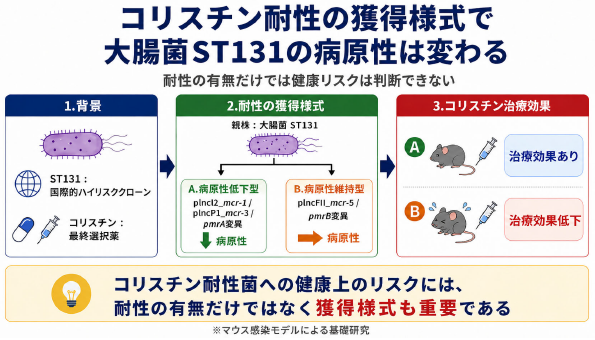
本研究の概要図
<関連情報>
- https://www.hokudai.ac.jp/news/2026/10/post-2471.htm
- https://www.thelancet.com/journals/ebiom/article/PIIS2352-3964(26)00307-5/fulltext
大腸菌クローンST131におけるコリスチン耐性因子の生体内比較評価 Comparative in vivo evaluation of colistin resistance determinants in Escherichia coli clone ST131
Toyotaka Sato ∙ Soh Yamamoto ∙ Jirachaya Toyting-Hiraishi ∙ Mana Tohyama ∙ Masaru Usui ∙ Hiharu Inoue ∙ et al.
eBioMedicine Published: August 5, 2026
DOI:https://doi.org/10.1016/j.ebiom.2026.106423
Summary
Background
Colistin is a last-resort antimicrobial for multidrug-resistant (MDR) Gram-negative infections. Health risks associated with colistin resistance are commonly inferred from resistance phenotypes, despite limited in vivo evidence linking resistance determinants to pathogenic outcomes. Whether distinct colistin resistance determinants confer differential clinical risks remains unknown.
Methods
Using the MDR Escherichia coli ST131 clone, we constructed isogenic mutants harbouring representative plasmid-mediated (mcr-encoding plasmids) or chromosomal (pmrAB) colistin resistance determinants. We systematically evaluated antimicrobial susceptibility, in vivo fitness, virulence, and therapeutic efficacy using murine infection models in female BALB/c mice. Transcriptomic, biochemical, and genetic analyses were performed to identify determinant-specific pathogenic mechanisms.
Findings
Clinical risk associated with colistin resistance was highly determinant-specific. Acquisition of pIncI2_mcr-1, pIncP1_mcr-3, or pmrA mutations significantly attenuated in vivo fitness and virulence, whereas pIncFII_mcr-5 and pmrB mutations preserved pathogenicity and caused marked colistin treatment failure. We identified two plasmid-encoded virulence attenuation factors, VafA and VafB, carried on pIncI2_mcr-1. These factors interacted with adenylate cyclase (CyaA), reprogrammed the ST131 transcriptome, suppressed purine biosynthesis, and reduced bacterial growth and virulence independently of colistin resistance itself.
Interpretation
Health risks of colistin-resistant E. coli cannot be inferred from resistance phenotypes alone. Determinant-specific in vivo evaluation reveals clinically important heterogeneity in pathogenic potential and treatment outcomes. Surveillance and risk assessment frameworks should prioritise resistance determinants that preserve virulence and compromise last-line therapy, rather than treating colistin resistance as a uniform clinical threat.
Funding
Food Safety Commission of Japan, the Japan Agency for Medical Research and Development (AMED), JSPS KAKENHI.

