
2026-04-16 ペンシルベニア州立大学(Penn State)
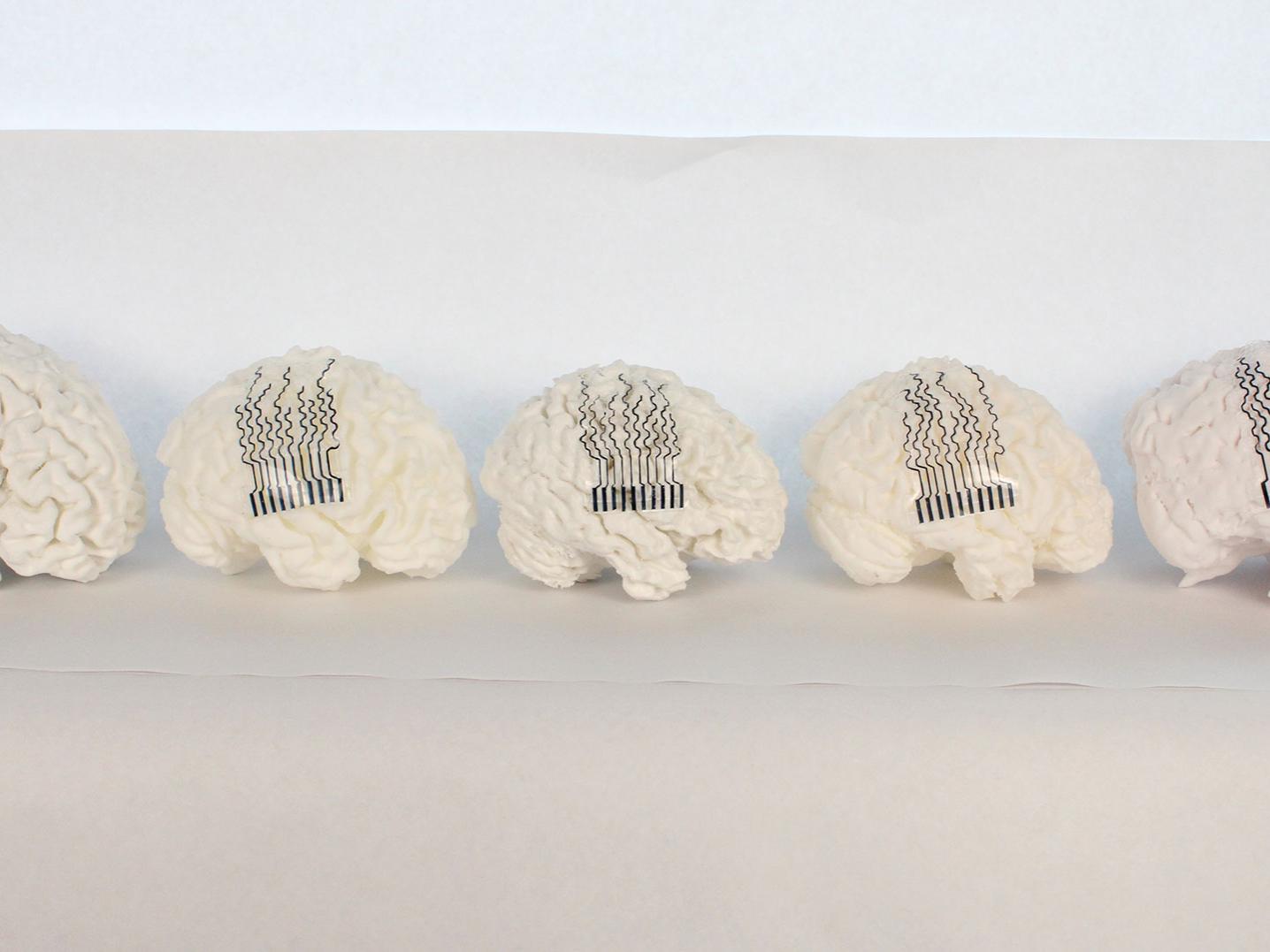
Using 3D-printed models of several patients’ brains, the team tested how well their electrodes could stretch to fit the individual cortical geometry – their electrodes can snugly fit atop the geometry of a patient’s brain with more precision than systems created with traditional methods. Credit: Provided by Tao Zhou. All Rights Reserved.
<関連情報>
- https://www.psu.edu/news/research/story/3d-printed-brain-sensors-may-unlock-personalized-neural-monitoring
- https://advanced.onlinelibrary.wiley.com/doi/10.1002/adma.202516291
患者固有の神経インターフェースのための、ハニカム構造に着想を得た3Dプリント可能な組織様生体電極 3D-Printable, Honeycomb-Inspired Tissue-Like Bioelectrodes for Patient-Specific Neural Interface
Marzia Momin, Luyi Feng, Xiaoai Chen, Salahuddin Ahmed, Basma AlMahmood, Li-Pang Huang, Jiashu Ren, Xinyi Wang, Hyunjin Lee, Samuel R. Cramer, Nanyin Zhang, Sulin Zhang, Tao Zhou
Advanced Materials Published: 14 March 2026
DOI:https://doi.org/10.1002/adma.202516291
ABSTRACT
The unique gyral patterns of the human brain demand patient-specific neural interfaces to achieve precise neuromodulation, mitigate adverse tissue responses, and optimize therapeutic efficacy and safety. One-size-fits-all, conventional rigid electrocorticography (ECoG) electrodes, standardized for mass production through lithographic techniques, exhibit limited conformability to the brain’s heterogeneous cortical topography. This mechanical mismatch results in poor electrode-tissue contact, signal loss, and foreign body responses. To address these limitations, we present an integrated novel platform, synergizing MRI-based anatomical mapping, finite element analysis (FEA)—optimized mechanical design, and direct ink writing (DIW) 3D printing to fabricate electrodes customized to individual gyral patterns. The resulting honeycomb-inspired printable gel electrode (HiPGE) employs a bioinspired honeycomb architecture with ultra-soft hydrogels, engineered to match the bending stiffness of brain tissue (0.1–10 kPa) while maintaining cost-efficiency and long-term durability. This mechanical congruence ensures exceptional cortical conformability and adaptive interfacing, circumventing the geometric and material limitations of traditional rigid electrodes. By combining patient-specific design with scalable fabrication, our platform establishes a transformative framework for neural interface engineering, enhancing precision, biocompatibility, and functional performance in neuromodulation therapies and neuroprosthetic applications.

