2026-10-19 ワシントン大学セントルイス校
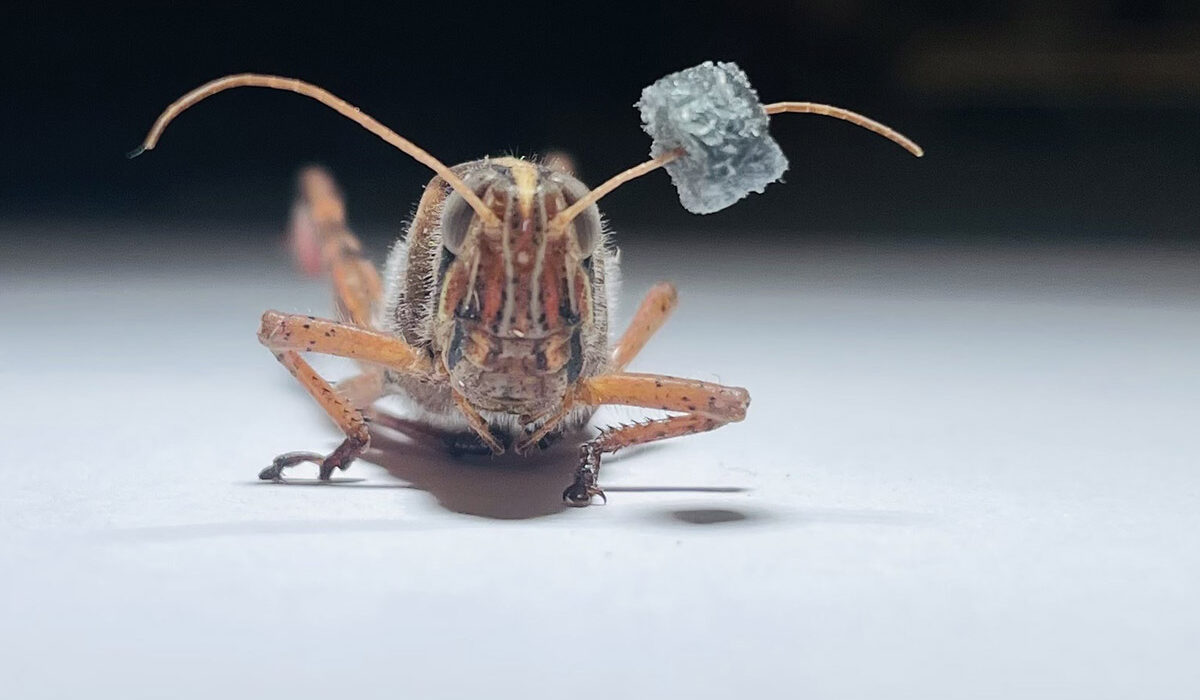
The antenna of a locust in Barani Raman’s lab is equipped with collagen foam containing nanomaterials that can detect and collect trace chemical signatures. Raman and colleague Srikanth Singamaneni, at WashU McKelvey Engineering, developed an approach that combines biological sensing with synthetic collection techniques, allowing for precise identification of certain compounds. (Photo: Raman lab)
<関連情報>
- https://source.washu.edu/2026/10/locusts-get-a-sensory-assist-from-nanomaterials/
- https://advanced.onlinelibrary.wiley.com/doi/10.1002/adma.75082
プラズモンフォームを用いたデュアルモードバイオハイブリッド化学センサー Plasmonic Foam-Enabled Dual-Modal Biohybrid Chemical Sensor
Avishek Debnath, Prashant Gupta, Rohit Gupta, Yixuan Wang, Yin-Yuan Huang, Feiyang Deng, Ramachandra Reddy Atigadda, Shantanu Chakrabartty, …
Advanced Materials Published: 23 September 2026
DOI:https://doi.org/10.1002/adma.75082
ABSTRACT
Chemical sensing systems with high sensitivity, molecular specificity, and universality across diverse chemical species are critical in numerous applications, including homeland security, environmental monitoring, industrial process monitoring, and healthcare. Existing synthetic chemical sensors remain suboptimal against their biological counterparts when sensitivity, specificity, versatility, and stability are evaluated jointly. Insect olfaction-based biohybrid sensors have been proposed, but their accuracy scales with the number of insects and does not extend across chemically diverse species, limiting universality. In this study, we overcome this deficiency by integrating the insect olfactory system with a synthetic chemical sensor, yielding a hybrid platform that identifies a broader range of chemicals than either system alone. We realized an ultralight, highly porous, three-dimensional (3D) surface-enhanced Raman scattering (SERS) substrate and interfaced it with the locust antenna and wings to harness the insect’s active odor-sampling abilities. Notably, the plasmonic foam provided molecular vibrational-fingerprint information without interfering with the insect’s innate chemical-sensing and locomotion abilities. By leveraging their complementary information, confidence-weighted fusion of neural and SERS responses outperformed either modality alone, improving odor-detection performance across all chemicals tested. This approach demonstrates the potential of interfacing functional nanomaterials with biological olfaction systems to create biohybrid chemical sensing systems with higher accuracy, specificity, and universality.