2026-11-02 沖縄科学技術大学院大学
沖縄科学技術大学院大学(OIST)、ドイツのキール大学、米国のマサチューセッツ工科大学(MIT)などの国際研究チームは、工業化社会と非工業化社会に暮らす人々の腸内細菌を比較し、生活環境の違いが細菌のゲノム進化に関係していることを明らかにした。研究では、両方の社会から十分な試料が得られた10種の腸内細菌を解析。その結果、工業化社会の人々から採取された菌株は、すべての菌種でタンパク質をコードする遺伝子を多く持ち、その差は8種で統計的に有意だった。さらに、系統樹リコンシリエーションという進化解析手法を用いて遺伝子獲得の時期と経路を推定したところ、遺伝子獲得の80~90%が水平遺伝子伝播によるものと判明した。獲得された遺伝子には、ストレス応答、細胞表層構造、代謝、ビタミンB12合成、リポ多糖産生に関わるものが含まれる。食生活、衛生環境、薬剤使用など、どの要因が変化を引き起こしたかは未解明だが、現代の生活様式が腸内細菌の進化に影響する可能性を示す成果である。
<関連情報>
工業化の勾配に沿ったヒト腸内細菌の収斂的ゲノム進化
Convergent genomic evolution of human gut bacteria along an industrialization gradient
Malte Rühlemann ∙ Yue Ma ∙ Lénárd L. Szánthó ∙ … ∙ Eric J. Alm ∙ Mathieu Groussin ∙ Mathilde Poyet
Cell Published:November 2, 2026
DOI:https://doi.org/10.1016/j.cell.2026.10.014

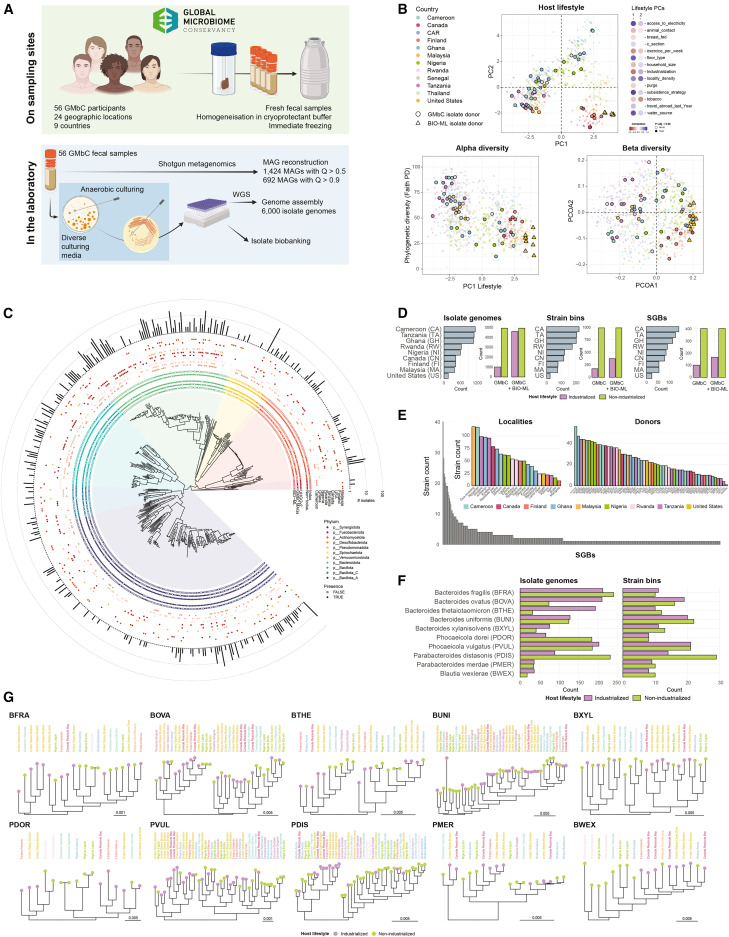
Figure 1 Geographic, species, strain, and host lifestyle diversity in the GMbC collection of human gut bacterial isolate genomes
Highlights
•Isolate bacterial genomes recover more accessory genes and HGT signals than MAGs
•Strains from industrialized hosts have larger proteomes and more fluid pangenomes
•Recent HGT-driven gene gains shape convergent lifestyle-associated gene profiles
•Genes and SNVs show convergent lifestyle-associated selection across species
Summary
Whether human-associated environments drive adaptive genome evolution in gut commensal bacteria remains largely unknown. Here, we investigate how genomic adaptation in gut bacteria differs between industrialized and non-industrialized human populations. We generated a collection of isolate genomes spanning diverse host geographies, lifestyles, species, and strains. We first found that, compared with metagenome-assembled genomes (MAGs), paired isolate genomes recover more functional elements and signals of horizontal gene transfer (HGT). Leveraging isolate genomes from multiple species, we find that strains from industrialized hosts experience an expansion of proteome size and harbor greater pangenome fluidity, driven by recent HGT events. Gene- and variant-level analyses reveal convergent patterns of lifestyle-specific adaptation in functions that are critical for ecological adaptation, such as the stress response, cell-envelope remodeling, and central metabolism. Our results demonstrate that industrialization drives convergent genome evolution in gut bacteria, providing a framework for understanding the mechanisms of microbial adaptation to rapidly changing human environments.