2026-11-05 東北大学
東北大学などの国際共同研究グループは、日本のカタツムリであるヒダリマキマイマイを用いて、動物の体の左右反転を引き起こす遺伝子を特定した。多くのカタツムリは右巻きの殻を持つが、同じ種の中に左巻きの個体が存在する。研究チームは、左巻きと右巻きの個体の全ゲノム情報を比較し、ミオシンIa/b遺伝子のDNA配列の違いが、体の左右性の決定に関与することを明らかにした。ミオシンは細胞骨格や細胞の運動・形状制御に関係するタンパク質である。今回の発見は、同遺伝子が動物の左右反転に関与することを初めて示したものであり、カタツムリの左右性が共通する遺伝子変異によって生じた可能性も示唆している。動物の左右非対称性は、内臓の配置や発生異常とも関係する重要な生物学的現象である。本研究は、動物の体の左右がどのように決まるのかという発生生物学の基本的な問題の解明に貢献する成果である。
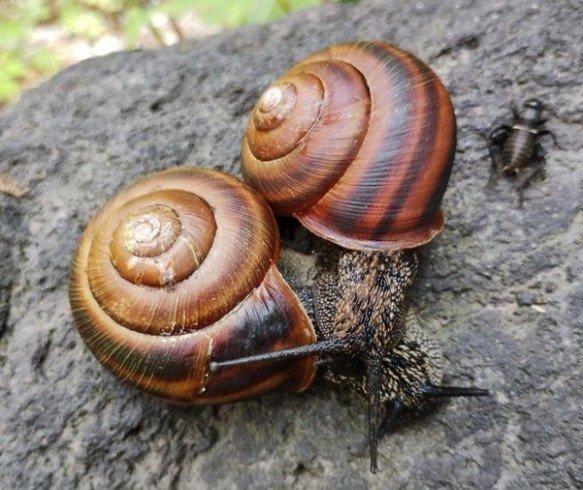
図1.ヒダリマキマイマイの右巻き個体(右)と左巻き個体(左)。
撮影:Angus Davison。
<関連情報>
- https://www.tohoku.ac.jp/japanese/2026/11/press20261105-04-snails.html
- https://www.sciencedirect.com/science/article/pii/S0960982226012698
ミオシンI a/bにおける古代の多型が、日本のカタツムリEuhadraのキラル変異を決定する An ancient polymorphism in myosin I a/b determines chiral variation in Japanese Euhadra snails
Alec Martin Lewis, Yasuto Ishii, Shun Ito, Kazuki Kimura, Margrethe Johansen, Alistair Nicholas Hume, Christopher Moore, Tom Hartman, Daniel John Jackson, Satoshi Chiba, Takahiro Hirano, Angus Davison
Current Biology Published: 16 October 2026
DOI:https://doi.org/10.1016/j.cub.2026.09.059
Highlights
- Chiral variation of Euhadra snails is due to a myosin I a/b gene
- Both chiral versions are ancient and not pathological
- Sinistral and dextral embryos show minimal transcriptional differences
- Dominant-acting amino acid substitutions may alter actomyosin interactions
Summary
Left-right (LR) asymmetry is a fundamental feature of animal development, yet progress in understanding its establishment has been limited by the fact that almost all animals do not ordinarily vary in the direction of their asymmetry. Snails are an exception because some wild-living species show abundant variation—externally visible in the shell coiling direction or “chirality”—yet the existing knowledge is from species, including the pond snail Lymnaea stagnalis, in which the sinistral mutation is rare and causes pathology. Here, we show that chiral polymorphism in Japanese Euhadra snails is due to functional variation in an unconventional myosin I a/b, a myosin family member not previously implicated in LR specification in any animal. Both the sinistral and dextral gene variants are ancient, impart minimal transcriptional differences in the single-cell embryo, and are not associated with pathology. Analyses show that relaxed selection enabled dominant-acting amino acid substitutions in the sinistral version of the Euhadra myosin motor domain and motor-lever junction, potentially affecting actomyosin interactions. For comparison, in the pond snail, we found that thousands of genes are differentially expressed between dextral and sinistral embryos due to the frameshift mutation in a formin gene. Overall, these results reinforce the role of myosin and actin-driven processes in LR symmetry breaking, broaden the known molecular repertoire, and highlight key mutations and positions in myosins that should be explored further, including in other animals.