2025-06-17 ヒューストン大学(UH)
<関連情報>
- https://uh.edu/news-events/stories/2025/june/06172025-berntsen-blink-choroid.php
- https://iovs.arvojournals.org/article.aspx?articleid=2802948
近視小児における遠近両用レンズ(BLINK)研究における多焦点コンタクトレンズ装用による眼窩下脈絡膜厚と面積の3年間の変化 Three-Year Change in Subfoveal Choroidal Thickness and Area With Multifocal Contact Lens Wear in the Bifocal Lenses in Nearsighted Kids (BLINK) Study
Maria K. Walker; David A. Berntsen; Matt L. Robich; Rachel L. Fenton; Anita Ticak; Justina R. Assaad; Hope M. Queener; Stephanie J. Chiu; Sina Farsiu; Donald O. Mutti; Lisa A. Jones-Jordan; Jeffrey J. Walline; for the BLINK Study Group
Investigative Ophthalmology & Visual Science Published:May 2025
DOI:https://doi.org/10.1167/iovs.66.5.5
Abstract
Purpose: To evaluate changes in subfoveal choroidal thickness and area in children wearing soft multifocal contact lenses (MFCLs) for myopia control.
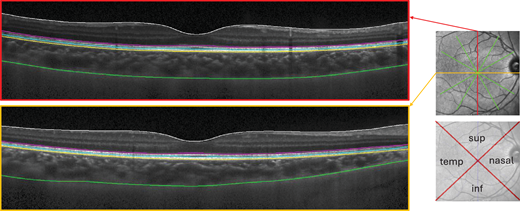
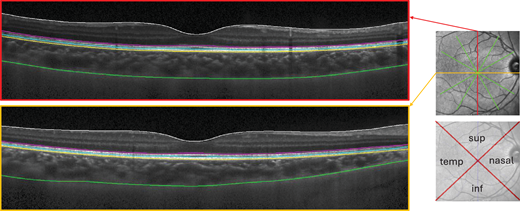
Methods: Analyses included 281 myopic children aged 7 to 11 years in the Bifocal Lenses in Nearsighted Kids (BLINK) Study randomly assigned to wear single vision contact lenses (SVCLs), +1.50 D add, or +2.50 D add center-distance MFCL. Subfoveal choroidal thickness and choroidal area were measured using spectral-domain optical coherence tomography before and after 2 weeks of lens wear, and then annually for 3 years. Repeated measures linear regression was used to determine the effect of contact lens wear on the choroid and test the association between choroidal changes and axial elongation.
Results: After initiating contact lens wear, mean ± SE subfoveal choroidal thickness and choroidal area increased in the +2.50 D MFCL group compared with the SVCL group by 8 ± 3 µm (P = 0.003) and 0.07 ± 0.02 mm2 (P = 0.002), a difference maintained throughout the 3-year study (P ≥ 0.55). Increased choroidal thickness and area after 2 weeks in the +2.50 D MFCL group vs. SVCL group were associated with less axial elongation over 3 years (β = -0.0058 mm/µm and -0.947 mm/mm2; P = 0.02 and P = 0.006; 20% and 29% of total treatment effect, respectively).
Conclusions: The choroid increased in subfoveal thickness and area after 2 weeks of +2.50 D MFCL wear, which was maintained for 3 years and was associated with slower axial elongation. However, only a portion of the treatment effect can be accounted for by the choroidal parameters.