2025-08-26 埼玉大学
<関連情報>
- https://www.saitama-u.ac.jp/topics_archives/202508261000.html
- https://www.saitama-u.ac.jp/media/pr202508261000.pdf
- https://onlinelibrary.wiley.com/doi/10.1111/tpj.70368
シアノバクテリアのジアシルグリセロールキナーゼは、膜脂質合成に関与し、光合成系IIの高光適応に寄与する Cyanobacterial diacylglycerol kinase is involved in membrane lipid synthesis and contributes to high-light acclimation of photosystem II
Kensuke Takagi, Yuki Nakamura, Haruhiko Jimbo, Hajime Wada
The Plant Journal Published: 20 August 2025
DOI:https://doi.org/10.1111/tpj.70368
SUMMARY
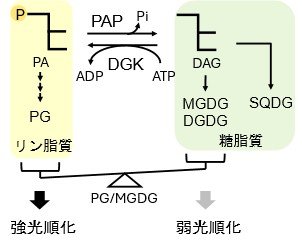
Photosynthetic organisms alter the lipid composition of the thylakoid membrane in response to environmental conditions. Phosphatidic acid (PA) is the branch point in the biosynthetic pathways of glycolipids and a phospholipid, phosphatidylglycerol (PG). PA and its dephosphorylated form, diacylglycerol (DG), are mutually convertible by PA phosphatase (PAP) and DG kinase (DGK). Thus, the activities of PAP and DGK appear to regulate the balance between glycolipids and PG in thylakoid lipid biosynthesis. However, the involvement of DGK and its function in the biosynthesis of thylakoid lipids and the regulation of the balance between glycolipids and PG has not yet been studied. In this study, we identified a dgkA gene encoding DGK in Synechocystis sp. PCC 6803 and generated a ΔdgkA mutant to study the function of DgkA in the response to high-light (HL) conditions. We observed that the wild-type (WT) cells exhibited higher PG content under high-light conditions than under low-light (LL) conditions. Conversely, in mutant cells, PG content did not increase in response to HL, and monogalactosyldiacylglycerol content was higher under both LL and HL conditions compared with WT. Additionally, the growth of the mutant cells was inhibited under HL conditions, and they showed a relatively higher extent of photoinhibition of photosystem II (PSII) due to a slower rate of the repair process. The supplementation of mutant cells with PG complemented this slower repair rate. These results suggested that DgkA is involved in the regulation of thylakoid lipid biosynthesis and contributes to the HL acclimation of PSII.
Significance Statement
Reassessment, including genetic testing, was performed in patients with a clinical diagnosis of hereditary polyneuropathy lacking genetic confirmation. A genetic or non-genetic etiology was identified in 44% of the patients.
We identified a dgkA gene for diacylglycerol kinase and generated a dgkA mutant of Synechocystis sp. PCC 6803. The content of phosphatidylglycerol was higher under high light than under low-light conditions in the wild-type cells. However, no such change was observed in the mutant. The mutant showed slower growth under high-light conditions and an enhanced photoinhibition of photosystem II. These findings suggest that DgkA is involved in lipid biosynthesis and contributes to high-light acclimation.