2025-10-13 ジョージア工科大学(Georgia Tech)
Web要約 の発言:
<関連情報>
- https://research.gatech.edu/undergraduate-bioinformatics-class-produces-published-research
- https://pubs.acs.org/doi/full/10.1021/acschembio.5c00507
- https://www.mdpi.com/1660-3397/21/1/53
海洋微小球菌における高度に保存された銅結合RiPP生合成遺伝子クラスターの系統ゲノム同定 Phylogenomic Identification of a Highly Conserved Copper-Binding RiPP Biosynthetic Gene Cluster in Marine Microbulbifer Bacteria
Yifan Tang,Weimao Zhong,Longping Fu,Emmanuel Asante,Anastasiia Kostenko,F. N. U. Vidya,Paige Mandelare-Ruiz,Tamilore T. Adeogun,Gabriel P. Anderson,Benjamin E. Edmonds,Oscar Fang,Michelle Han,Alia S. Hollingsworth,Amna R. Ingham,Carlyn R. Kirby,Alice Landrum,Connor R. Mack,Nikki S. Nobari,Emma J. Oswald,Cecilia L. Polevoy,Yasmin Sharifian,Timothy J. So,Joelee R. Stokes,Reniya S. Thompson,Rishabh Vuthamaraju,Elaine C. Wang,William H. Yang,Alison E. Onstine,Valerie J. Paul,Ronghu Wu,Allegra T. Aron,and Vinayak Agarwal
ASC Chemical Biology Published: September 19, 2025
DOI:https://doi.org/10.1021/acschembio.5c00507
Abstract
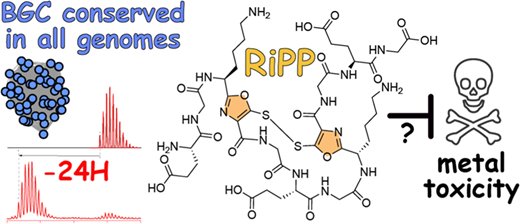
Conserved biosynthetic gene clusters (BGCs) are often tied to the production of natural products that perform critical functions in an organism’s physiology and ecological interactions. Here, by phylogenetic analysis across the bacterial genus, we report the obligate conservation of a BGC in genomes of cosmopolitan marine Microbulbifer bacteria. This genus is a common member of marine microbiomes, and this BGC was conserved in Microbulbifer genomes regardless of phylogenetic or geographical dispersal. The post-translationally modified peptidic product encoded by this BGC─which was accessed via heterologous production and its structure elucidated using a combination of mass spectrometry and NMR spectroscopy─was found to be a copper chelator. Similar BGCs were then found in genomes of other marine bacterial genera coinhabiting the microbiomes of sponges and corals. The phylogenomic workflows described herein were implemented in a pedagogic setting at the Georgia Institute of Technology to provide hands-on instruction to undergraduate students in bacterial phylogeny, genome mining, and natural product chemistry.
大規模培養と質量分析に基づくメタボロミクスによって明らかになった、共生細菌と海綿動物ホロバイオント間の限定的なメタボロミクス重複:ジョージア工科大学の学部生実験教育的取り組み Limited Metabolomic Overlap between Commensal Bacteria and Marine Sponge Holobionts Revealed by Large Scale Culturing and Mass Spectrometry-Based Metabolomics: An Undergraduate Laboratory Pedagogical Effort at Georgia Tech
Jessica M. Deutsch,Madison O. Green,Priyanka Akavaram,Ashleigh C. Davis,Sarth S. Diskalkar,Isabelle A. Du Plessis,Hannah A. Fallon,Emma M. Grason,Emma G. Kauf,Zoe M. Kim,Jeffrey R. Miller II,Abby L. Neal,Tatiana Riera,Sofie-Ellen Stroeva,Jollin Tran,Vivi Tran,Azucena Velgara Coronado,Vanessa Velgara Coronado,Benjamin T. Wall,Chung mo Yang,…
Marine Drugs Published: 14 January 2023
DOI:https://doi.org/10.3390/md21010053
Abstract
Sponges are the richest source of bioactive organic small molecules, referred to as natural products, in the marine environment. It is well established that laboratory culturing-resistant symbiotic bacteria residing within the eukaryotic sponge host matrix often synthesize the natural products that are detected in the sponge tissue extracts. However, the contributions of the culturing-amenable commensal bacteria that are also associated with the sponge host to the overall metabolome of the sponge holobiont are not well defined. In this study, we cultured a large library of bacteria from three marine sponges commonly found in the Florida Keys. Metabolomes of isolated bacterial strains and that of the sponge holobiont were compared using mass spectrometry to reveal minimal metabolomic overlap between commensal bacteria and the sponge hosts. We also find that the phylogenetic overlap between cultured commensal bacteria and that of the sponge microbiome is minimal. Despite these observations, the commensal bacteria were found to be a rich resource for novel natural product discovery. Mass spectrometry-based metabolomics provided structural insights into these cryptic natural products. Pedagogic innovation in the form of laboratory curricula development is described which provided undergraduate students with hands-on instruction in microbiology and natural product discovery using metabolomic data mining strategies.