2026-05-01 広島大学

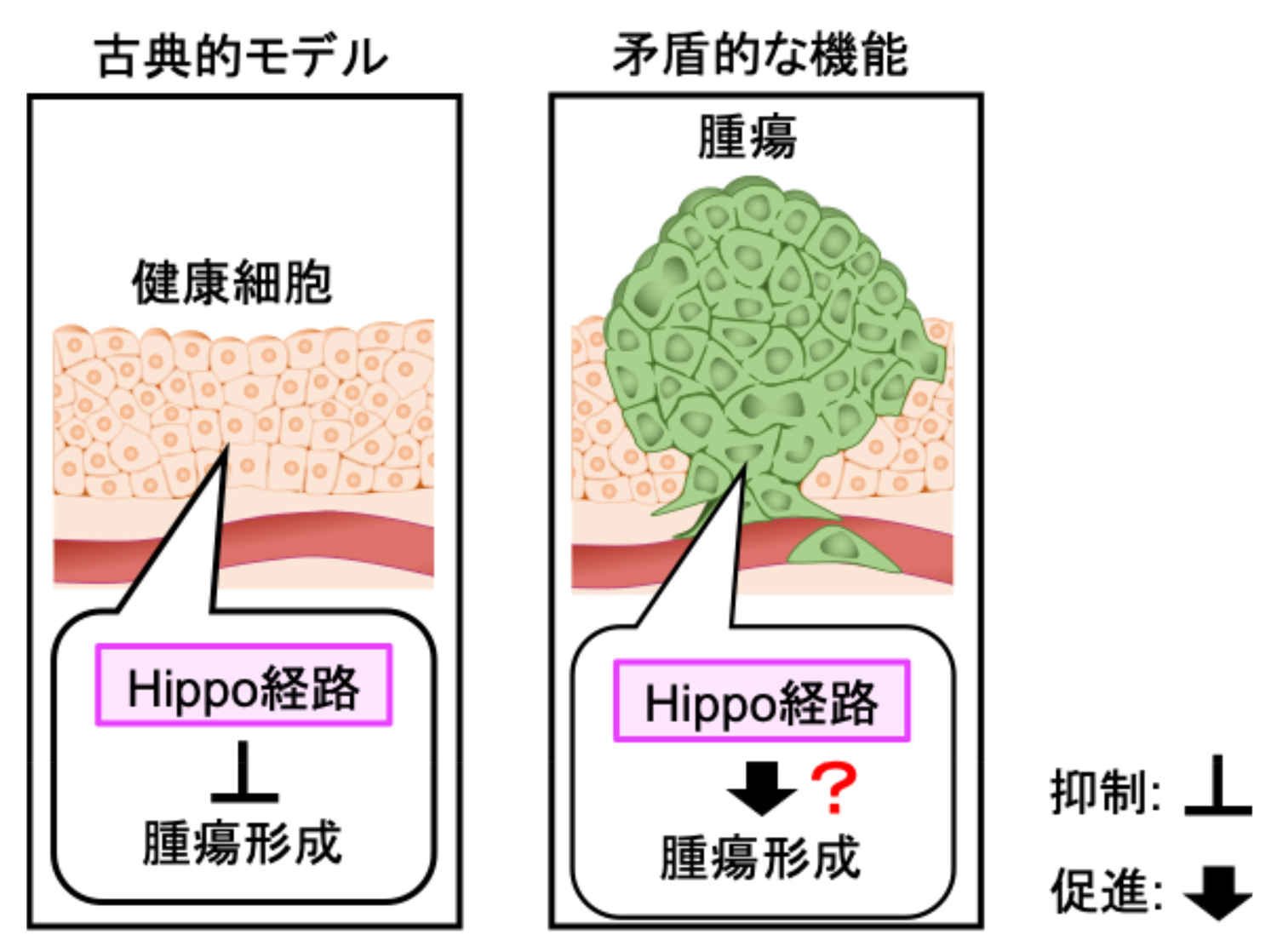
図1 Hippo経路による腫瘍形成への2つの作用
古典的モデル(左): Hippo経路による腫瘍“抑制”効果。矛盾的な機能(右): Hippo経路による腫瘍“促進”効果。Hippo経路は腫瘍形成を“抑制”すると考えられてきたが、いくつかのがんでは腫瘍形成を“促進”する。この促進効果についてはほとんど理解されていない。
<関連情報>
- https://www.hiroshima-u.ac.jp/news/97253
- https://link.springer.com/article/10.1038/s44319-026-00778-5
Hippo腫瘍抑制経路はショウジョウバエにおいて非細胞自律的な腫瘍形成を引き起こす The Hippo tumor suppressor pathway triggers non-cell autonomous tumorigenesis in Drosophila
Daichi Honda,Misako Okumura,Ayano Oi,Chisako Sakuma,Fumiaki Obata,Toshinori Ando,Masayuki Miura & Takahiro Chihara
EmBO Reports Published:01 May 2026
A News & Views to this article was published on 01 May 2026
DOI:https://doi.org/10.1038/s44319-026-00778-5
Abstract
The Hippo pathway is a tumor suppressor pathway, and most related studies have indicated that its inhibition leads to tumorigenesis. However, recent studies have suggested that the activated Hippo pathway can promote tumorigenesis in certain contexts. Here, we demonstrate that the activated Hippo pathway induces non-cell-autonomous tumorigenesis, characterized by tumor markers in the Drosophila wing epithelium. This suggests that Hippo-activated cells behave similarly to “oncogenic niche cells.” We find that Hippo-activated cells induce Dronc-Wingless/Spitz signaling in the hinge/ventral notum region, which causes tumorigenesis. Moreover, we identify the amino acid transporters Sat1/2, which are implicated in amino acid incorporation and function redundantly with the growth factors Wingless and Spitz to facilitate non-cell-autonomous tumorigenesis.
Synopsis

Hippo signaling in Drosophila wing discs promotes the growth of neighboring tumors. This non-cell-autonomous effect depends on growth factor signaling and amino acid transporters.
- Hippo signaling induces tumorigenesis in neighboring cells.
- Growth factors Wg and Spitz mediate this non-cell-autonomous effect.
- The amino acid transporters Sat1 and Sat2 enhance amino acid uptake to enable tumor initiation.
- Sat1 and Sat2 cooperate with Wg and Spitz to drive tumorigenesis.