2026-02-19 東京農工大学
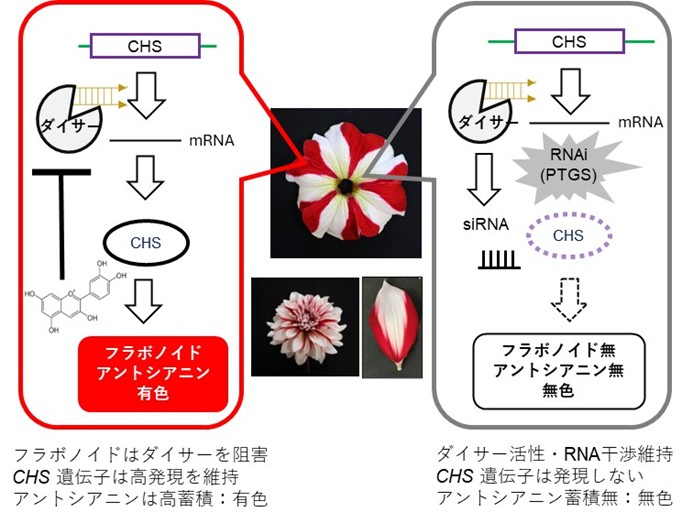
図2:ダリア・ペチュニアの2色模様の花ができるしくみ:
<関連情報>
- https://www.tuat.ac.jp/outline/disclosure/pressrelease/2025/20260219_01.html
- https://academic.oup.com/pcp/advance-article-abstract/doi/10.1093/pcp/pcag013/8454612
Dicer-like 4とフラボノイドアグリコンの双方向フィードフォワード制御ループはペチュニアとダリアの花の二色パターンを引き起こす Bidirectional feedforward regulatory loop of Dicer-like 4 and flavonoid aglycons causes floral bicolor patterning in petunia and dahlia
Kazunori Kuriyama,Sho Ohno,Midori Tabara,Niichi Yamazaki,Keita Sawai,Hiroshi Tsugawa,Hisashi Koiwa,Hiromitsu Moriyama,Toshiyuki Fukuhara
Plant and Cell Physiology Published:02 February 2026
DOI:https://doi.org/10.1093/pcp/pcag013
Abstract
Floral bicolor pigmentation in some cultivars of petunia and dahlia is caused by naturally occurring RNA interference (RNAi). In both species, the chalcone synthase gene is highly expressed only in the pigmented regions of bicolor petals. However, the mechanism by which RNAi is specifically induced in the unpigmented regions remains unknown. To elucidate the mechanism underlying this bicolor pattern formation, we analyzed the dicing activity of Dicer-like 4 (DCL4), an essential enzyme in the RNAi pathway. Crude extracts prepared from the pigmented regions strongly inhibited DCL4 activity, whereas this inhibition was abolished when flavonoids were removed from the extracts. Further analyses revealed that the inhibitory activity was attributable to flavonoid aglycons. In vivo dicing activity was detected only in colorless protoplasts prepared from the unpigmented regions of bicolor dahlia petals. These results indicate that in the unpigmented regions, flavonoid aglycons that inhibit DCL4 are not synthesized, allowing RNAi to remain active. In contrast, in the pigmented regions of mature petals, DCL4—and consequently RNAi—is inhibited by flavonoid aglycons, allowing anthocyanin biosynthesis to maintain. Exogenous application experiments of flavonoid aglycons to floral apexes with small flower buds support this conclusion. Therefore, during bicolor flower development, at the stage when petals mature, the clear bicolor pattern is established through a bidirectional feedforward loop involving mutual antagonism between DCL4 and flavonoid aglycons.