2026-02-26 科学技術振興機構,東京大学,大阪大学,久留米大学
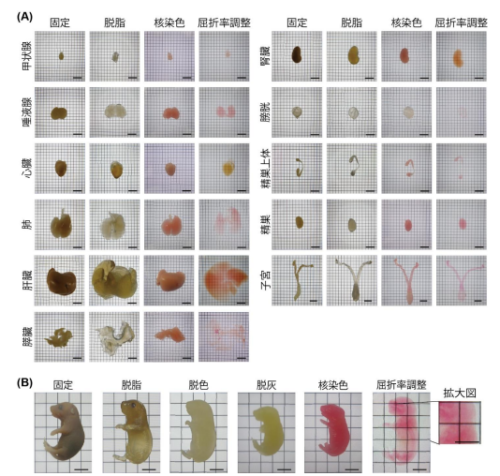
図 1 組織透明化のプロセス
脱脂および屈折率調整の処理時間や方法を最適化することで高い透明度を達成した。(A)成体マウスの 11 臓器の組織透明化。(B)新生仔マウス全身の組織透明化。
<関連情報>
- https://www.jst.go.jp/pr/announce/20260226/index.html
- https://www.jst.go.jp/pr/announce/20260226/pdf/20260226.pdf
- https://www.cell.com/cell/abstract/S0092-8674(25)01507-7
全臓器および全身の3Dアトラスにより細胞全体のプロファイリングが可能 Whole-organ and whole-body 3D atlases enable cellome-wide profiling
Shota Y. Yoshida ∙ Katsuhiko Matsumoto ∙ Satoshi Takagi ∙ … ∙ Eiichi Morii ∙ Etsuo A. Susaki ∙ Hiroki R. Ueda
Cell Published:February 25, 2026
DOI:https://doi.org/10.1016/j.cell.2025.12.057
Highlights
- We created organ-/body-wide whole-cell atlases (CUBIC Organ/Body Atlas) of mice
- Each atlas contains all cell coordinates in major organs and a whole neonatal body
- Advanced system rapidly collected single-cell-resolution images across samples
- This resource aids cellomics studies on diseases and developmental processes
Summary
Recent advancements in tissue clearing and light-sheet fluorescence microscopy have enabled whole-organ/body-scale analysis at single-cell resolution. However, comprehensive bioinformatics resources like digitized whole-cellome maps, analogous to whole-genome sequencing, remain limited. Here, we present the CUBIC Organ/Body Atlas, a set of three-dimensional single-cell-resolution references for eleven adult mouse organs and a neonatal whole-mouse body. To generate this atlas, we optimized tissue clearing protocols and developed exMOVIE, an imaging system achieving sufficient working distance and axial resolution for organ-/body-wide three-dimensional imaging and subsequent cell nuclei detection. The atlas facilitates comparative analysis among multiple samples at single-cell resolution, allowing for applications in organ development studies, disease state analysis, and whole-body immune cell profiling with three-dimensional immunostaining. Thus, the CUBIC Organ/Body Atlas contributes to establishing a common cellomics workflow, advancing our systems-level understanding of organisms in physiological, developmental, and pathological processes.