2026-02-27 愛媛大学
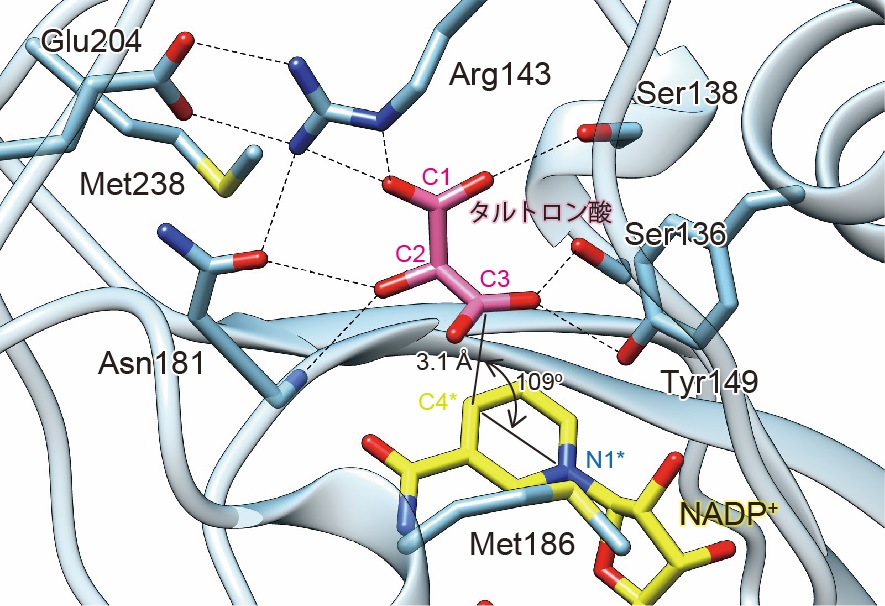
Ltn3Dの補酵素(NADP+)・阻害剤(タルトロン酸)複合体の結晶構造
<関連情報>
- https://www.ehime-u.ac.jp/data_relese/pr_20260227_agr/
- https://www.ehime-u.ac.jp/wp-content/uploads/2026/02/pr_20260227_agr.pdf
- https://www.jbc.org/article/S0021-9258(26)00150-X/fulltext
新奇 L-スレオン酸 3-脱水素酵素の同定、機能的特徴化および構造解析 Identification, functional characterization, and structural analysis of an atypical L-threonate 3-dehydrogenase
Seiya Watanabe ∙ Himika Sato ∙ Taiyo Yokoi ∙ Shin-ichi Terawaki
Journal of Biological Chemistry Published:February 11, 2026
DOI:https://doi.org/10.1016/j.jbc.2026.111280
Summary
Diverse bacteria possess unusual gene clusters containing cryptic genes of unknown function, which are often related to metabolism of sugars and sugar acids. In 1964, Aspen and Jakoby first isolated and characterized an NAD+-dependent L-threonate 3-dehydrogenase (Ltn3D; EC 1.1.1.29) from Pseudomonas sp. (J Biol Chem 239, 710-713), the molecular identity of which has remained unknown for over 60 years. Here, we have utilized bacterial genome context, together with biochemical and structural characterization, to reveal that GL300_RS07945 in Paracoccus litorisediminis encodes a representative NADP+-preferring Ltn3D. Crystal structure of the Michaelis ternary complex indicated that this enzyme is a member of the short-chain dehydrogenases/reductase superfamily, yet differed in the recognizing of the 2’-phosphate group of NADP+ between two adjacent arginine residues (Arg33 and Arg34). The C-3 atom of the competitive inhibitor tartronate was rationally positioned in close proximity to the nicotinamide ring for the catalysis. The reaction catalyzed by Ltn3D constitutes a distinct bypass route for the direct conversion of L-threonate to 3-oxo-L-threonate, which differs from the known sequential steps involving a dehydrogenase (Ltn2D) and an isomerase (OtnI). In contrast to Ltn2D, Ltn3D efficiently oxidized the 3-OH of homologous five- and six-carbon sugar acids, in addition to L-threonate. Among them, D-gluconate, potentially produced by GL300_RS07940 as a bifunctional 2-keto-D-gluconate/2-keto-L-gluconate reductase, could be converted to D-ribulose 5-phosphate by Ltn3D followed by the action of a kinase (3OtnK) and a decarboxylase (3OtnC) in vitro. Altogether, our data suggest that Ltn3D constitutes a unique evolutionary innovation for the catabolism of four- to six-carbon sugar acids.