2026-04-15 東北大学
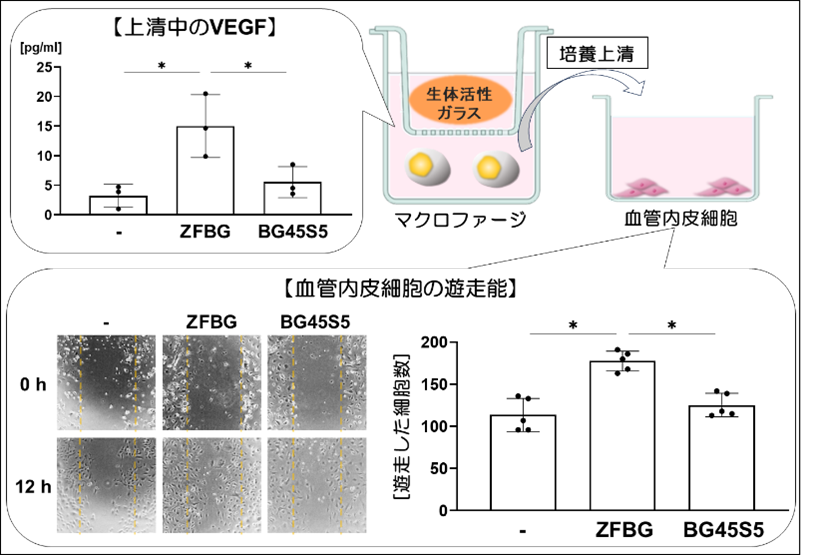
図1.新規生体活性ガラス(ZFBG)によるマクロファージのVEGF発現誘導と血管内皮細胞遊走能の促進
<関連情報>
- https://www.tohoku.ac.jp/japanese/2026/04/press20260415-02-bone.html
- https://www.tohoku.ac.jp/japanese/newimg/pressimg/tohokuuniv-press20260415_02_bone.pdf
- https://www.nature.com/articles/s41598-026-44931-5
亜鉛およびフッ素含有バイオアクティブガラスは、M2dマクロファージの活性化を介して血管新生を介した骨再生を促進する Zinc- and fluoride-containing bioactive glass enhances angiogenesis-mediated bone regeneration via M2d macrophage activation
Koki Otake,Takeru Kondo,Hiroaki Kakinuma,Yumi Sato,Sara Ambo,Amal Ashry,Kulapatch Engkatanachai,Jun Sato & Hiroshi Egusa
Scientific Reports Published:13 April 2026
DOI:https://doi.org/10.1038/s41598-026-44931-5
Abstract
Angiogenesis is crucial for bone regeneration because it supplies oxygen and nutrients to developing tissues. Immune cells, particularly macrophages, play an important role in regulating vascularization. The M2d macrophage subtype, which is phenotypically similar to tumor-associated macrophages, is characterized by high vascular endothelial growth factor (VEGF) expression; however, its role in regenerative angiogenesis and bone regeneration remains unclear. In this study, we developed a zinc- and fluoride-containing phosphate-based bioactive glass (ZFBG) by incorporating ZnO, CaF2, and Al2O3 into a phosphate glass network. Compared with conventional silicate-based bioactive glass (BG45S5), ZFBG exhibited superior ion release and solubility under physiological conditions. In vitro, ZFBG polarized macrophages toward the VEGF-producing M2d phenotype, and conditioned media from these macrophages significantly enhanced endothelial cell migration. In a mouse calvarial defect model, ZFBG increased M2d macrophage accumulation, CD31+ neovascularization, bone volume, and bone mineral density relative to BG45S5. ZFBG showed minimal direct effects on human umbilical vein endothelial cells, suggesting that its proangiogenic effects are primarily macrophage mediated. Collectively, these findings suggest that ZFBG is associated with enhanced angiogenesis-related bone regeneration, potentially through modulation of VEGF-producing macrophages, and highlight the promise of ion-releasing bioactive glasses for immune-mediated bone repair.