2026-04-15 東京大学
<関連情報>
- https://www.u-tokyo.ac.jp/content/400285948.pdf
- https://www.cambridge.org/core/journals/british-journal-of-nutrition/article/development-of-a-twelveitem-screener-for-assessing-diet-quality-in-japan/5547512EA4BB9C5D96EC59603F52DA16
日本における食生活の質を評価するための12項目からなるスクリーニングツールの開発 Development of a twelve-item screener for assessing diet quality in Japan
Fumi Oono,Nana Shinozaki[,Riho Adachi,Keiko Asakura,Shizuko Masayasu,Satoshi Sasaki andKentaro Murakami
British Journal of Nutrition Published:14 April 2026
DOI:https://doi.org/10.1017/S0007114526106837
Abstract
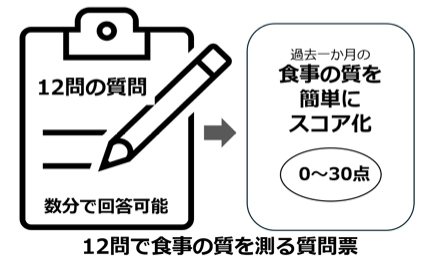
Evidence-based diet quality screeners that can be completed within a few minutes are suitable tools for evaluating diet quality in time-limited settings; however, no such tool has yet been developed in Japan. This study aimed to develop a screener to assess adherence to the Diet Quality Score for Japanese (DQSJ) and to describe its development process. The DQSJ is a 10-component index that was previously developed. The present study developed questions and assigned scores based on dietary data analysis and evidence on diet-health associations. Dietary data from 392 Japanese adults were analysed to identify the intake of food groups in the DQSJ. The mean intakes of 4-non-consecutive-day dietary records were described for each food group across the consumption frequencies in dietary questionnaires. Questions about sodium intake were derived from a sodium screener. Consequently, the DQSJ screener comprised 12 questions: two for red and processed meat, two for sodium and one for each of the other eight food groups (fruits, vegetables, whole grains, nuts, legumes, dairy, fish and sugar-sweetened beverages). The screener asked about the number of servings consumed for vegetables, dairy and sugar-sweetened beverages and the consumption frequencies for the other food groups. The maximum scores were assigned with consideration of optimal and feasible consumption for health outcomes. The total DQSJ was calculated by summing all item scores, resulting in a range of 0–30. The DQSJ screener has the potential to facilitate the assessment of diet quality in time-limited settings in Japan; the next step is to examine its validity.