2026-04-29 パシフィック・ノースウェスト国立研究所(PNNL)
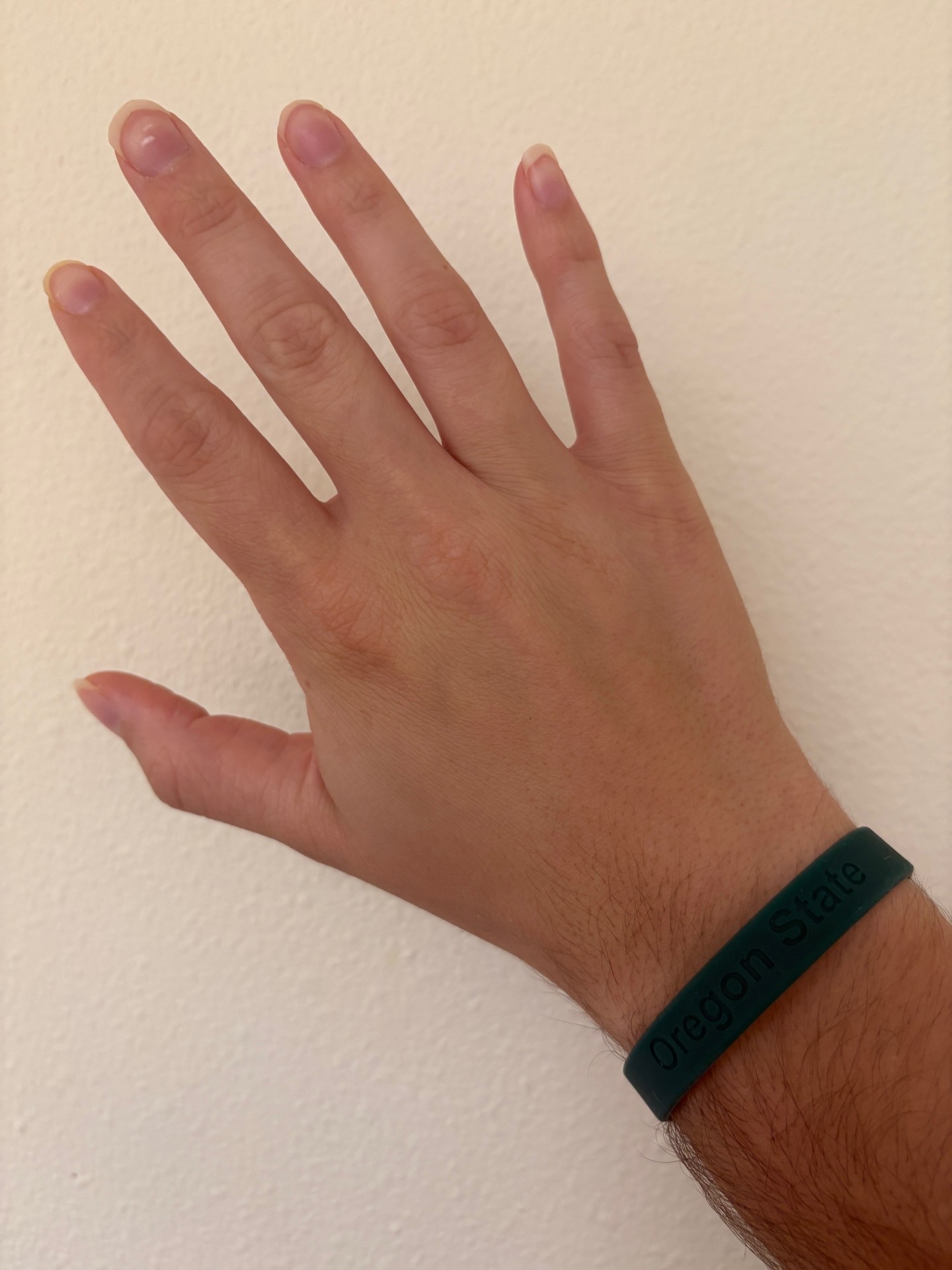
Researchers used wristband samplers to record the exposures of study participants. (Photo courtesy of Oregon State University)
<関連情報>
- https://www.pnnl.gov/news-media/exploring-exposome
- https://www.sciencedirect.com/science/article/pii/S0269749125019232?via%3Dihub
- https://www.nature.com/articles/s41370-025-00822-x#Ack1
- https://agupubs.onlinelibrary.wiley.com/doi/10.1029/2023GH000937
シリコン製リストバンドの繰り返しサンプリングにより特定された多環芳香族炭化水素曝露の個人および環境的予測因子 Personal and environmental predictors of polycyclic aromatic hydrocarbon exposure identified through repeated silicone wristband sampling
Emily M. Bonner, Alison E. Clark, Lisa M. Bramer, Diana Rohlman, Lane G. Tidwell, Katrina M. Waters, Kim A. Anderson
Environmental Pollution Available online: 17 December 2025
DOI:https://doi.org/10.1016/j.envpol.2025.127549
Highlights
- Personal exposure assessments benefit from collection of questionnaire data.
- Silicone wristbands enabled collection of repeated measures with high compliance.
- Repeated measures yield variability metrics and better represent personal exposure.
- Important determinants of PAH exposure included month and flooring types.
Abstract
This study integrates quantitative data on personal exposure to polycyclic aromatic hydrocarbons (PAHs) in 162 silicone wristbands with demographics, behavioral information, and housing characteristics to explore contributions to residential exposure in a community influenced by historic and current industrial activities over the course of a year. Forty-six residents completed questionnaires and wore silicone wristbands as personal passive samplers for seven consecutive days on up to four separate occasions between November 2022 and June 2023; the repeated measures in this study lend insight into exposure sources with variability. It was hypothesized that individual behaviors and housing characteristics would be sources of dependence and correlation between personal PAH exposures. Fifty PAHs were detected, seventeen of which were alkylated PAHs. Exposure to PAHs of similar molecular weight was often correlated, notably between naphthalenes (2-rings) and PAHs of 3 or more rings. Generalized linear mixed models identified flooring type, participant age, and sampling month as predictors of increased PAH exposure. Flooring type and use of wood stoves or heavy machinery were identified as predictors of increased naphthalene exposure relative to larger PAHs. Personal behaviors and housing characteristics were sources of dependence and correlation between personal PAH exposures across repeated measures. We demonstrate the value of collection and integration of questionnaire data with exposure data, and repeated measures that consider intra-individual variability. Identification of influential exposure factors through repeated measures of chemical exposure and characterization of variability in personal exposure as performed in this study is important in the development of exposure mitigation strategies.
個人における化学物質曝露の変動性を特徴づけ、エクスポソミクスを改善する Characterizing variability in personal chemical exposure to improve exposomics
Lisa M. Bramer,Holly M. Dixon,Alison E. Clark,Diana Rohlman,Katrina M. Waters & Kim A. Anderson
Journal of Exposure Science & Environmental Epidemiology Published:17 November 2025
DOI:https://doi.org/10.1038/s41370-025-00822-x
Abstract
Background
Understanding how chemical exposure varies within and between people over time is a critical component of characterizing the exposome—the totality of lifetime exposures. However, variability remains an understudied aspect of exposomic research.
Objective
Our objective was to investigate trends in variability for chemical exposure data between and within people that appear across differing study designs.
Methods
Thirty-five people in Eugene, Oregon, and 46 people in St. Helens, Oregon, wore silicone wristbands over multiple seasons, including a span of heavy wildfire smoke in Eugene. Each participant wore between four and 14 wristbands. We analyzed 586 wristbands for 94 (Eugene) and 58 (St. Helens) chemicals. While analytic tests differed between the studies, the same 43 polycyclic aromatic hydrocarbons (PAHs) were measured in both studies. We also evaluated three environmental variables for their impact on chemical concentrations. We fit generalized mixed effects models to each chemical, and used variance partitioning to understand and quantify sources of variability across environmental factors and inter- and intra-individual variables.
Results
We observed PAHs that were consistent within people across different days. For a subset of these PAHs, results did not agree well between studies, indicating the importance of measuring chemical data at different time points across studies. Environmental variables were not sufficient for explaining data variability for most chemicals. Only 21% and 30% of the modeled chemicals for Eugene and St. Helens, respectively, had a combined environmental variable R2 at or above 0.1. Yet, environmental factors still revealed valuable information; we observed higher combined R2 values for styrene, o-xylene, ethylbenzene, and phenanthrene in the Eugene detection model, which came from a combination of fine particulate matter and smoke density information.
Impact Statement
- Our manuscript is the largest investigation of intra- and inter- variability in silicone wristband concentrations, containing over 23,000 chemical data points across two different personal chemical exposure studies.
- Certain chemicals were consistent within people across different days.
- For a subset of chemicals, results did not agree well between the two wristband studies.
- Our findings highlight the importance of measuring chemical data at different time points across studies to better understand the exposome.
- Environmental variables included in this study were not sufficient for explaining the data variability for most chemicals.
PM2.5だけでは、個人のPAH曝露を説明するには不十分である PM2.5 Is Insufficient to Explain Personal PAH Exposure
Lisa M. Bramer, Holly M. Dixon, Diana Rohlman, Richard P. Scott, Rachel L. Miller, Laurel Kincl, Julie B. Herbstman, Katrina M. Waters, Kim A. Anderson
GeoHealth Published: 10 February 2024
DOI:https://doi.org/10.1029/2023GH000937
Abstract
To understand how chemical exposure can impact health, researchers need tools that capture the complexities of personal chemical exposure. In practice, fine particulate matter (PM2.5) air quality index (AQI) data from outdoor stationary monitors and Hazard Mapping System (HMS) smoke density data from satellites are often used as proxies for personal chemical exposure, but do not capture total chemical exposure. Silicone wristbands can quantify more individualized exposure data than stationary air monitors or smoke satellites. However, it is not understood how these proxy measurements compare to chemical data measured from wristbands. In this study, participants wore daily wristbands, carried a phone that recorded locations, and answered daily questionnaires for a 7-day period in multiple seasons. We gathered publicly available daily PM2.5 AQI data and HMS data. We analyzed wristbands for 94 organic chemicals, including 53 polycyclic aromatic hydrocarbons. Wristband chemical detections and concentrations, behavioral variables (e.g., time spent indoors), and environmental conditions (e.g., PM2.5 AQI) significantly differed between seasons. Machine learning models were fit to predict personal chemical exposure using PM2.5 AQI only, HMS only, and a multivariate feature set including PM2.5 AQI, HMS, and other environmental and behavioral information. On average, the multivariate models increased predictive accuracy by approximately 70% compared to either the AQI model or the HMS model for all chemicals modeled. This study provides evidence that PM2.5 AQI data alone or HMS data alone is insufficient to explain personal chemical exposures. Our results identify additional key predictors of personal chemical exposure.
Plain Language Summary
Tools are needed to determine how chemical exposures may affect people’s health. It is not understood how air quality data from stationary air monitors and smoke density data from satellites align with personal chemical exposure data from silicone wristbands; we present the first study to evaluate this. In this study, people wore wristbands, carried phones to track their locations, and answered questions for a week in different seasons. We also collected fine particulate matter data from outdoor monitors and satellites and tested the wristbands for 94 different chemicals. The results showed that the wristband data, along with other information like where people spent time and the air quality, varied between seasons. We used machine learning models to predict personal chemical exposure using only the data from monitors or satellites, and then using a mix of data from both, along with additional data about the environment and people’s behaviors. Models that used a mix of data were much better at predicting exposure compared to using just one type of data. This study tells us that using fine particulate data from monitors or satellites is not enough to understand personal chemical exposure.