2026-05-20 成育医療研究センター
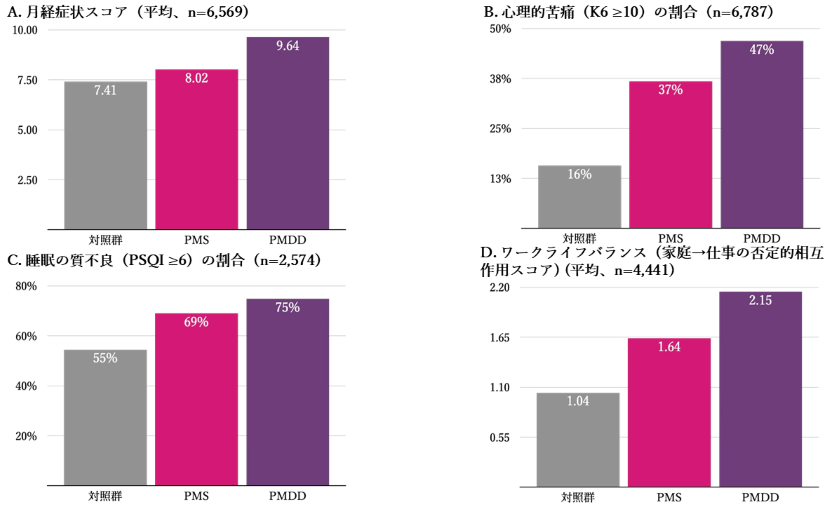
【図1:月経症状および心理社会的指標の分布】
※各項目はデータの抜けなどで解析対象数が異なる。PMS=月経前症候群、PMDD=月経前不快気分障害
<関連情報>
- https://www.ncchd.go.jp/press/2026/0520.html
- https://obgyn.onlinelibrary.wiley.com/doi/10.1002/ijgo.70752
月経前症候群の心理社会的要因と月経周期との関連性:地域ベースの研究 Psychosocial and menstrual correlates of premenstrual disorders: A community-based study
Shiori Itoi, Makiko Sampei, Takayuki Tatsumi, Yutaka Osuga, Kaori Koga, Satoshi Narumi, Naho Morisaki
International Journal of Gynecology & Obstetrics Published: 15 December 2025
DOI:https://doi.org/10.1002/ijgo.70752
Abstract
Objective
To assess the background, psychosocial, and menstrual factors associated with premenstrual syndrome (PMS) and premenstrual dysphoric disorder (PMDD) in a community-based cohort.
Methods
A prospective cohort study was conducted using data from users of a menstrual tracking application. Participants were classified into control, PMS, or PMDD groups based on responses to the Japanese version of the premenstrual symptoms screening tool (PSST). Primary outcomes included background factors (e.g., healthcare literacy, stress coping), psychosocial measures (psychological distress, sleep quality, and work–home balance), and menstrual characteristics (average cycle length [CL], CL variability, abnormal cycle length, and menstrual symptoms). Age-adjusted multinomial logistic regression models were used to examine associations.
Results
A total of 7227 individuals were included; 23% met criteria for PMS and 10% for PMDD. Both PMS and PMDD were associated with younger age, smoking history (current and past), more adverse childhood experiences, lower healthcare literacy, and higher maladaptive coping scores. PMDD was additionally linked to being married and co-residing with children, while PMS was associated with alcohol consumption. Both groups reported higher levels of psychological distress, poor sleep quality, and negative work–home balance. Although the prevalence of abnormal cycle length did not differ between groups, menstrual symptom burden was greater in both PMS and PMDD.
Conclusion
Premenstrual disorders are associated with a wide range of sociodemographic and psychosocial difficulties. Although menstrual irregularities were similar across groups, menstrual symptom burden was markedly higher. These findings underscore the need for targeted, multidisciplinary support.